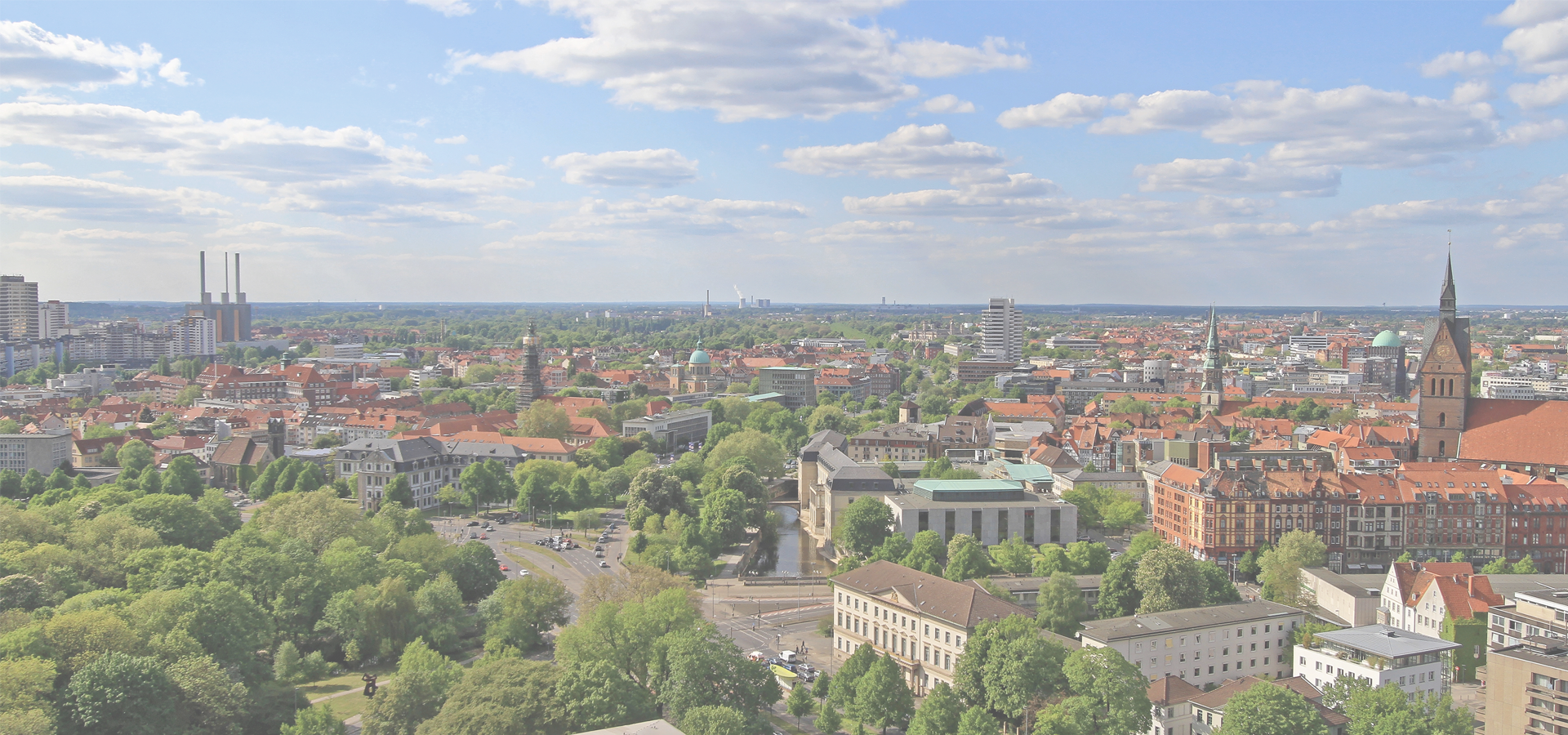
🇩🇪 Hanover (Hannover) is the capital and largest city of the German state of Lower Saxony. It is the 13th largest city in Germany as well as the third-largest city in Northern Germany. Hanover's urban area comprises the towns of Garbsen, Langenhagen and Laatzen. The city lies at the confluence of the River Leine and its tributary Ihme, in the south of the North German Plain, and is the largest city in the Hannover–Braunschweig–Göttingen–Wolfsburg Metropolitan Region. It is the fifth-largest city in the Low German dialect area.
The city is a major crossing point of railway lines and motorways (Autobahnen), connecting European main lines in both the east-west (Berlin–Ruhr area/Düsseldorf/Cologne) and north-south (Hamburg–Frankfurt/Stuttgart/Munich) directions. Hannover Airport lies north of the city, in Langenhagen, and is Germany's ninth-busiest airport. The city's most notable institutes of higher education are the Hannover Medical School (Medizinische Hochschule Hannover), one of Germany's leading medical schools, with its university hospital Klinikum der Medizinischen Hochschule Hannover, and the Leibniz University Hannover.
The Hanover fairground, owing to numerous extensions, especially for the Expo 2000, is the largest in the world. Hanover hosts annual commercial trade fairs such as the Hanover Fair and up to 2018 the CeBIT. The IAA Commercial Vehicles show takes place every two years. It is the world's leading trade show for transport, logistics and mobility. Every year Hanover hosts the Schützenfest Hannover, the world's largest marksmen's festival, and the Oktoberfest Hannover.
Etymology The name of the city may derive from the German (am) hohen Ufer, literally 'on the high (river) bank'. Traditionally, the English spelling is ⟨Hanover⟩. However, ⟨Hannover⟩, the German spelling with a double-⟨n⟩, has become more popular in English. Recent editions of Encyclopædia Britannica prefer the German spelling, and the local government uses the German spelling on their English webpages. The English pronunciation, with stress on the first syllable, is applied to both the German and English spellings, which is different from German pronunciation, with stress on the second syllable and a long second vowel. The traditional English spelling is still used in historical contexts, especially when referring to the British House of Hanover.
History Hanover was founded in medieval times on the east bank of the Leine River. Its original name Honovere may mean 'high river bank', but that is debated. Hanover was a small village of ferrymen and fishermen that became a comparatively large town in the 13th century and received town privileges in 1241 because of its position at a natural crossroads. As overland travel was relatively difficult, its position on the upper navigable reaches of the river helped it grow from increasing trade. It was connected to the Hanseatic League city of Bremen by the Leine River and was situated near the southern edge of the wide North German Plain and north-west of the Harz mountains, so east–west traffic such as mule trains passed through it. Hanover was thus a gateway to the Rhine, Ruhr and Saar river valleys, and their industrial areas which grew up to the south-west and the plains regions to the east and north for overland traffic skirting the Harz between the Low Countries and Saxony or Thuringia.
In the 14th century, the main churches of Hanover were built, as well as a city wall with three city gates. The beginning of industrialization in Germany led to trade in iron and silver from the northern Harz Mountains, which increased the city's importance.
In 1636 George, Duke of Brunswick-Lüneburg, ruler of the Brunswick-Lüneburg principality of Calenberg, moved his residence to Hanover. The Dukes of Brunswick-Lüneburg were elevated by the Holy Roman Emperor to the rank of Prince-Elector in 1692, which was confirmed by the Imperial Diet in 1708. Thus, the principality was upgraded to the Electorate of Brunswick-Lüneburg, colloquially known as the Electorate of Hanover after Calenberg's capital (see also House of Hanover). Its electors later became monarchs of Great Britain (and from 1801 of the United Kingdom of Great Britain and Ireland). The first of them was George I Louis, who acceded to the British throne in 1714. The last British monarch who reigned in Hanover was William IV. Semi-Salic law, which required succession by the male line if possible, forbade the accession of Queen Victoria in Hanover. As a male-line descendant of George I, Queen Victoria was herself a member of the House of Hanover. Her descendants, however, bore her husband's titular name of Saxe-Coburg-Gotha. Three kings of Great Britain, or the United Kingdom, were concurrently also Electoral Princes of Hanover.
During the time of the personal union of the crowns of the United Kingdom and Hanover (1714–1837), the monarchs rarely visited the city. In fact during the reigns of the last three joint rulers (1760–1837), there was only one short visit, by George IV in 1821. From 1816 to 1837, Viceroy Adolphus represented the monarch in Hanover.
During the Seven Years' War, the Battle of Hastenbeck was fought near the city on 26 July 1757. The French army defeated the Hanoverian Army of Observation, which led to the city's occupation as part of the Invasion of Hanover. It was recaptured by Anglo-German forces, led by Ferdinand of Brunswick, the following year.
History: 19th century After Napoleon imposed the Convention of Artlenburg (treaty of the Elbe) on 5 July 1803, about 35,000 French soldiers occupied Hanover. The convention also required disbanding the Hanoverian Army. However, George III did not recognise the Convention of the Elbe, which resulted in a great number of soldiers from Hanover eventually emigrating to Great Britain, where the King's German Legion was formed. It was only troops from Hanover and Brunswick who consistently opposed France throughout the Napoleonic Wars. The Legion later played an important role in the Peninsular War and the Battle of Waterloo in 1815. In 1814 the electorate became the Kingdom of Hanover.
In 1837, the personal union of the United Kingdom and Hanover ended because William IV's heir in the United Kingdom was female (Queen Victoria). Hanover could be inherited only by male heirs. Thus, Hanover passed to William IV's brother, Ernest Augustus, and remained a kingdom until 1866, when it was annexed by the Prussia during the Austro-Prussian war. Though Hanover was expected to defeat Prussia at the Battle of Langensalza in 1866, Prussia employed Moltke the Elder's Kesselschlacht order of battle to and destroyed the Hanoverian Army. Thereafter the city of Hanover became the capital of the Prussian Province of Hanover.
In 1872, the first horse railway was inaugurated, and in 1893, an electric tram was installed.
A local newspaper, the Hannoverscher Kurier, was published in Hanover at this time.
Nazi era After 1937 the lord mayor and the state commissioners of Hanover were members of the NSDAP (Nazi party). A large Jewish population then existed in Hanover. In October 1938, 484 Hanoverian Jews of Polish origin were expelled to Poland, including the Grynszpan family. However, Poland refused to accept them, leaving them stranded at the border with thousands of other Polish-Jewish deportees, fed only intermittently by the Polish Red Cross and Jewish welfare organisations. The Grynszpans' son Herschel Grynszpan was in Paris at the time. When he learned of what was happening, he drove to the German embassy in Paris and shot the German diplomat Eduard Ernst vom Rath, who died shortly afterwards.
The Nazis took this act as a pretext to stage a nationwide pogrom known as Kristallnacht (9 November 1938). On that day, the synagogue of Hanover, designed in 1870 by Edwin Oppler in neo-romantic style, was burnt by the Nazis.
History: World War II In September 1941, through the "Action Lauterbacher" plan, a ghettoisation of the remaining Hanoverian Jewish families began. Even before the Wannsee Conference, on 15 December 1941, the first Jews from Hanover were deported to Riga. A total of 2,400 people were deported, and very few survived. During the war seven concentration camps were constructed in Hanover, in which many Jews were confined, but also Polish, French and Russian women. Of the approximately 4,800 Jews who had lived in Hanover in 1938, fewer than 100 were still in the city when troops of the United States Army arrived on 10 April 1945 to occupy Hanover at the end of the war. Today, a memorial at the Opera Square is a reminder of the persecution of the Jews in Hanover. After the war a large group of Orthodox Jewish survivors of the nearby Bergen-Belsen concentration camp settled in Hanover.
There was also a camp for Sinti and Romani people (see Romani Holocaust), and dozens of forced labour subcamps of the Stalag XI-B prisoner-of-war camp for Allied POWs.
As an important railway and road junction and production centre, Hanover was a major target for strategic bombing during World War II, including the Oil Campaign. Targets included the AFA (Stöcken), the Deurag-Nerag refinery (Misburg), the Continental plants (Vahrenwald and Limmer), the United light metal works (VLW) in Ricklingen and Laatzen (today Hanover fairground), the Hanover/Limmer rubber reclamation plant, the Hanomag factory (Linden) and the tank factory M.N.H. Maschinenfabrik Niedersachsen (Badenstedt). Residential areas were also targeted, and more than 6,000 civilians were killed by the Allied bombing raids. More than 90% of the city centre was destroyed in a total of 88 bombing raids. After the war, the Aegidienkirche was not rebuilt and its ruins were left as a war memorial. Today around 25% of the city consists of buildings from before 1950.
The Allied ground advance into Germany reached Hanover in April 1945. The US 84th Infantry Division captured the city on 10 April 1945.
Post-war Hanover was in the British zone of occupation of Germany and became part of the new state (Land) of Lower Saxony in 1946. In 1947, Hanover established its relationship with Bristol, England in exchanges of goods, students and music. This would link the two cities as models for establishing programs and organizations like Sister Cities International.
Today Hanover is a vice-president city of Mayors for Peace, an international mayoral organisation mobilising cities and citizens worldwide to abolish and eliminate nuclear weapons by 2020.
Subdivisions The city of Hanover is divided into 13 boroughs (Stadtbezirke) and 53 quarters (Stadtteile): Boroughs 1 Mitte; 2 Vahrenwald-List; 3 Bothfeld-Vahrenheide; 4 Buchholz-Kleefeld; 5 Misburg-Anderten; 6 Kirchrode-Bemerode-Wülferode; 7 Südstadt-Bult; 8 Döhren-Wülfel; 9 Ricklingen; 10 Linden-Limmer; 11 Ahlem-Badenstedt-Davenstedt; 12 Herrenhausen-Stöcken; 13 Nord; Quarters A selection of the 53 quarters: • Nordstadt • Südstadt • Oststadt • Zoo (for the zoo itself, see Hanover Zoo) • Herrenhausen • Waldheim.
Economy Various industrial businesses are located in Hannover. The Volkswagen Commercial Vehicles Transporter (VWN) factory at Hannover-Stöcken is the biggest employer in the region and operates a large plant at the northern edge of town adjoining the Mittellandkanal and Motorway A2. Volkswagen shares a coal-burning power plant with a factory of German tire and automobile parts manufacturer Continental AG. Continental AG, founded in Hanover in 1871, is one of the city's major companies.
The audio equipment company Sennheiser and the travel group TUI AG are both based in Hanover.[Hanover is home to many insurance companies including Talanx, VHV Group, and Concordia Insurance. The major global reinsurance company Hannover Re also has its headquarters east of the city centre. Among the largest employers in Hanover are: Volkswagen Commercial Vehicles (VWN), Klinikum Region Hannover, Hannover Medical School, Continental, Deutsche Bahn, TUI, DHL, Nord/LB, Talanx, WABCO, VHV Group.
In 2012, the city generated a GDP of €29.5 billion, which is equivalent to €74,822 per employee. The gross value of production in 2012 was €26.4 billion, which is equivalent to €66,822 per employee.
Around 300,000 employees were counted in 2014. Of these, 189,000 had their primary residence in Hanover, while 164,892 commute into the city every day.
In 2014 the city was home to 34,198 businesses, of which 9,342 were registered in the German Trade Register and 24,856 counted as small businesses. Hence, more than half of the metropolitan area's businesses in the German Trade Register are located in Hanover (17,485 total).
Business development Hannoverimpuls GMBH is a joint business development company from the city and region of Hannover. The company supports the start-up, growth and relocation of businesses in the Hannover Region. The focus is on thirteen sectors, which stand for sustainable economic growth: Automotive, Energy Solutions, Information and Communications Technology, Life Sciences, Optical Technologies, Creative Industries and Production Engineering. A range of programmes supports companies from the key industries in their expansion plans in Hannover or abroad. Three regional centres specifically promote international economic relations with Russia, India and Turkey.
The Institut für Integrierte Produktion Hannover is a spin-off from Leibniz University Hanover in the field of production technology that promotes transfer of scientific knowledge to business.
Education The Leibniz University Hanover is the largest funded institution in Hanover for providing higher education to students from around the world. Below are the names of the universities and some of the important schools, including newly opened Hannover Medical Research School in 2003 for attracting the students from biology background from around the world.
There are several universities in Hanover: • Leibniz University Hannover, host institution to the Max Planck Institute for Gravitational Physics • Hochschule für Musik, Theater und Medien Hannover • Hannover Medical School • School of Veterinary Medicine Hanover (Tierärztliche Hochschule Hannover) • GISMA Business School, part of the for-profit education company Global University Systems.
There is one University of Applied Science and Arts in Hanover: • Hochschule Hannover (the former Fachhochschule)
The Schulbiologiezentrum Hannover maintains practical biology schools in four locations (Botanischer Schulgarten Burg, Freiluftschule Burg, Zooschule Hannover, and Botanischer Schulgarten Linden). The University of Veterinary Medicine Hanover also maintains its own botanical garden specialising in medicinal and poisonous plants, the Heil- und Giftpflanzengarten der Tierärztlichen Hochschule Hannover.
Hannover has several vocational schools like Berufsbildende Schulen (BBS) ME - Metalltechnik und Elektrotechnik, which specializes in metal and electrical engineering, and BBS Cora Berliner, which specializes in business administration as well as the leisure and trading industries.
Hannover is ranked #75 by the Global Urban Competitiveness Report (GUCR) which evaluates and ranks world cities in the context of economic competitiveness. Hannover was ranked #861 by the Nomad List which evaluates and ranks remote work hubs by cost, internet, fun and safety. Hannover has a population of over 535,061 people. Hannover also forms part of the wider Hannover-Braunschweig-Göttingen-Wolfsburg metropolitan area which has a population of over 3,900,000 people. Hannover was the #253 hipster city in the world, with a hipster score of 3.0566 according to the Hipster Index which evaluates and ranks the major cities of the world according to the number of vegan eateries, coffee shops, tattoo studios, vintage boutiques, and record stores. Hannover is situated near Hanover.
To set up a UBI Lab for Hannover see: https://www.ubilabnetwork.org Twitter: https://twitter.com/UBILabNetwork
Hannover is a member of the UNESCO Creative Cities Network for Music see: https://en.unesco.org/creative-cities
UNESCO Creative Cities for Music include: 🇦🇺 Adelaide 🇰🇿 Almaty 🇵🇹 Amarante 🇮🇩 Ambon 🇳🇿 Auckland 🇧🇦 Banja Luka 🇮🇳 Benares 🇬🇼 Bissau 🇨🇴 Bogotá 🇮🇹 Bologna 🇮🇹 Bolzano 🇨🇬 Brazzaville 🇨🇿 Brno 🇵🇱 Bydgoszcz 🇻🇪 Caracas 🇮🇳 Chennai 🇻🇳 Da Lat 🇲🇦 Essaouira 🇨🇱 Frutillar 🇧🇪 Ghent 🏴 Glasgow 🇮🇳 Gwalior 🇯🇵 Hamamatsu 🇩🇪 Hannover 🇨🇺 Havana 🇵🇹 Idanha-a-Nova 🇲🇾 Ipoh 🇺🇸 Kansas City 🇵🇱 Katowice 🇷🇺 Kazan 🇯🇲 Kingston 🇹🇷 Kırşehir 🇺🇦 Kyiv 🇵🇹 Leiria 🏴 Liverpool 🇪🇸 Llíria 🇩🇪 Mannheim 🇫🇷 Metz 🇲🇽 Mexicali 🇨🇭 Montreux 🇲🇽 Morelia 🇸🇪 Norrköping 🇮🇹 Pesaro 🇹🇹 Port of Spain 🇨🇻 Praia 🇵🇸 Ramallah 🇧🇷 Salvador 🇮🇷 Sanandaj 🇹🇷 Şanlıurfa 🇩🇴 Santo Domingo 🇪🇸 Seville 🇹🇭 Suphan Buri 🇰🇷 Tongyeong 🇫🇷 Toulouse 🇨🇴 Valledupar 🇨🇱 Valparaíso 🇮🇳 Varanasi 🇭🇷 Varaždin 🇷🇺 Veliky Novgorod 🇭🇺 Veszprém 🇷🇸 Vranje
🇩🇪 Hersfeld-Rotenburg 9.75
🇩🇰 Fredericia 9.75
🇩🇪 Bad Waldsee 9.75
🇩🇪 Karlstadt am Main 9.767
🇩🇪 Biberach an der Riß 9.783
🇩🇪 Biberach an der Riss 9.783
🇩🇪 Schwäbisch Hall 9.733
🇩🇪 Langenhagen 9.733
🇩🇪 Bad Hersfeld 9.707
🇩🇪 Bad Fallingbostel 9.693
Locations Near: Hannover 9.73815,52.3723
🇩🇪 Hanover 9.738,52.368 d: 0.5
🇩🇪 Langenhagen 9.733,52.433 d: 6.8
🇩🇪 Garbsen 9.583,52.417 d: 11.6
🇩🇪 Hildesheim 9.951,52.151 d: 28.6
🇩🇪 Celle 10.063,52.614 d: 34.7
🇩🇪 Bodenwerder 9.517,51.967 d: 47.6
🇩🇪 Bad Fallingbostel 9.693,52.866 d: 55
Antipodal to: Hannover -170.262,-52.372
🇹🇴 Nuku'alofa -175.216,-21.136 d: 16515.7
🇹🇴 Nukuʻalofa -175.2,-21.133 d: 16515.6
🇦🇸 Pago Pago -170.701,-14.279 d: 15779.2
🇼🇸 Apia -171.76,-13.833 d: 15727.6
🇵🇫 Papeete -149.566,-17.537 d: 15740.5
🇺🇸 Hilo -155.089,19.725 d: 11864.5
🇺🇸 Maui -156.446,20.72 d: 11777.9
🇺🇸 Maui County -156.617,20.868 d: 11764.3