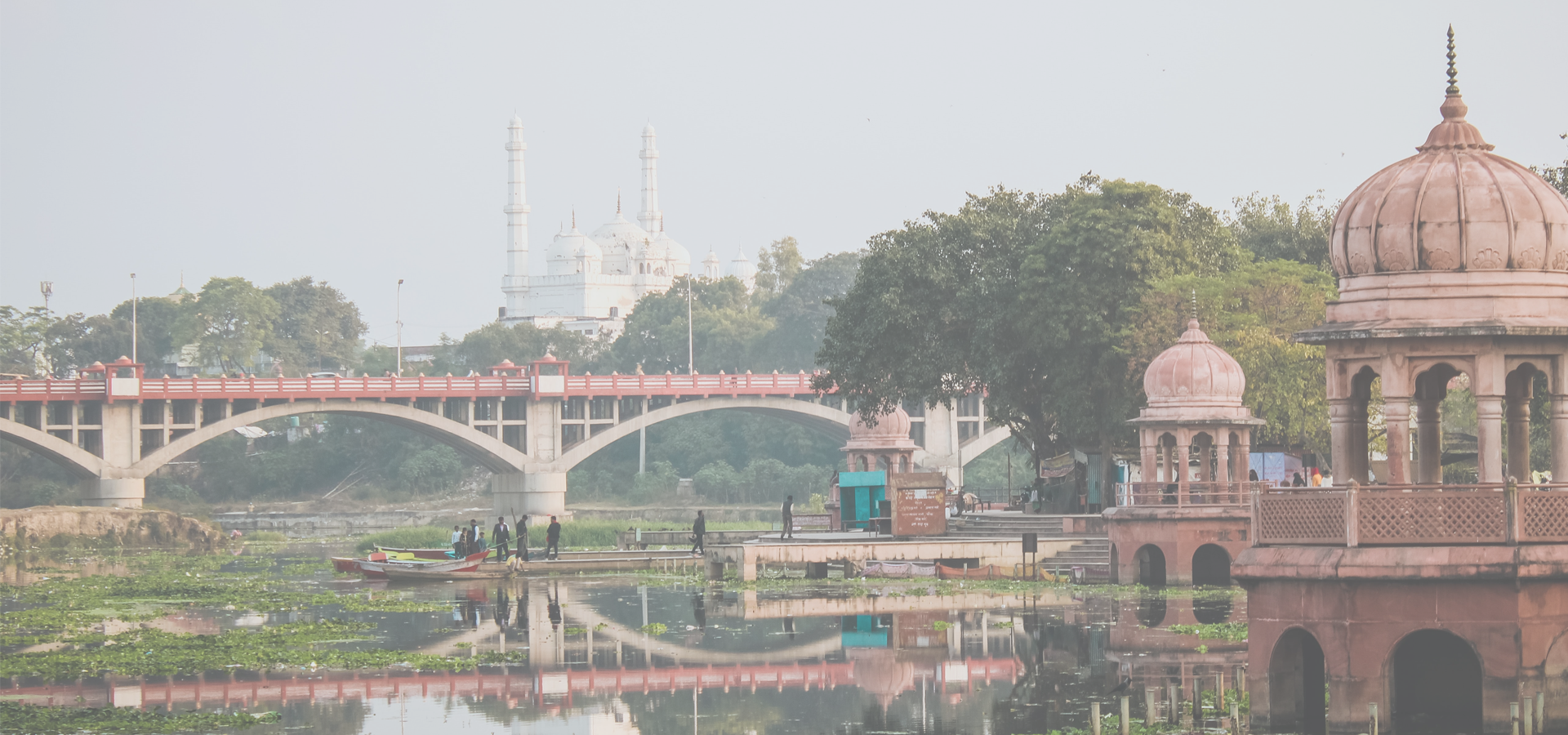
Vrindavan, Uttar Pradesh, India

Etymology | History | Geography | Demographics | Religious heritage | Temples | City of Widows | Culinary tradition | Transport : Road : Rail | Flight

🇮🇳 Vrindavan, also spelt Vrindaban and Brindaban, is a historical city in the Mathura district of Uttar Pradesh, India. It is one of the most sacred places in Vaishnavism. It is located in the Braj Bhoomi region, and is where, according to Hinduism, Krishna spent most of his childhood days. The city is about 11 km from Mathura, Krishna's birthplace on the Agra–Delhi National Highway as NH-44. The town hosts many temples dedicated to the worship of Radha and Krishna. Vrindavan forms a part of the "Krishna pilgrimage circuit" under development by the Indian Ministry of Tourism. The circuit also includes Mathura, Barsana, Gokul, Govardhan, Kurukshetra, Dwarka and Puri.

Etymology The ancient Sanskrit name of the city, वृन्दावन (Vṛndāvana), comes from its groves of vṛndā (holy basil) and vana (grove, forest).

History Vrindavan has an ancient past, associated with Hindu culture and history, and was established in the 16th and 17th centuries as a result of an explicit treaty between Muslims and Hindu Emperors, and is an important Hindu pilgrimage site since long.

In contemporary times, Vallabha Charya, aged eleven visited Vrindavan. Later on, he performed three pilgrimages of India, barefoot giving discourses on Bhagavad Gita at 84 places. These 84 places are known as Pushtimarg Baithak and since then have the places of pilgrimage. Yet, he stayed in Vrindavan for four months each year. Vrindavan thus heavily influenced his formation of Pushtimarg.

The essence of Vrindavan was lost over time until the 16th century when it was rediscovered by Chaitanya Mahaprabhu. In the year 1515, Chaitanya Mahaprabhu visited Vrindavan, with the purpose of locating the lost holy places associated with Krishna's life.

In the last 250 years, the extensive forests of Vrindavan have been subjected to urbanisation, first by local Rajas and in recent decades by apartment developers. The forest cover has been whittled away to only a few remaining spots, and the local wildlife, including peacocks, cows, monkeys and a variety of bird species has been virtually eliminated.

Geography Situated on the west bank of the Yamuna River, about 15 km north of Mathura and 125 km from Delhi, Vrindavan has an average elevation of 170 metres (557 feet). The Yamuna river flows through the city.

Demographics As of 2011 Indian Census, Vrindavan had a total population of 63,005, of which 34,769 were males and 28,236 were females. The population within the age group of 0 to 6 years was 7,818. The total number of literates in Vrindavan was 42,917, which constituted 68.11% of the population with male literacy of 73.7% and female literacy of 61.2%. The effective literacy rate of the 7+ population of Vrindavan was 77.8%, of which the male literacy rate was 83.7% and the female literacy rate was 70.3%. The sex ratio is 812 females per 1000 males. The Scheduled Castes and Scheduled Tribes population was 6,294 and 18, respectively. Vrindavan had 11,637 households in 2011.

Vrindavan lies in the cultural region of Braj.

Religious heritage Vrindavan is considered to be a sacred place for Vaisnavism tradition of Hinduism. It is believed that Krishna spent part of his childhood in this city. The other prominent areas surrounding Vrindavan are Govardhana, Gokul, Nandgaon, Barsana, Mathura and Bhandirvan. Along with Vrindavan, all these places are considered to be the centre of Radha and Krishna worship. Millions of devotees of Radha Krishna visit Vrindavan and its nearby areas every year to participate in a number of festivals. The common salutation or greetings used in Braj region by its residents is Radhe Radhe which is associated with the Goddess Radha or Hare Krishna which is associated with Krishna. Devotees of Krishna believe that he visits the town each night to adore Radha.

Temples Vrindavan, the land of Radha Krishna has about 5500 temples dedicated to them to showcase their divine pastimes. Some of the important pilgrimage sites are - • Shri Radha Madan Mohan Temple, located near the Kalidah Ghat was built by Kapur Ram Das of Multan. One of the oldest temples in Vrindavan, it is closely associated with Chaitanya Mahaprabhu. The original deity of Madan Gopal was shifted from the shrine to Karauli in Rajasthan for safekeeping during Aurangzeb's rule. Today, a replica of the original (deity) is worshipped at the temple • Sri Radha Raman Mandir, constructed at the request of Gopala Bhatta Goswami and houses a saligram deity of Krishna as Radha Ramana, alongside Radha. • Banke Bihari Temple, built in 1862 after the image of Banke-Bihari was discovered in Nidhivan by Swami Haridas. • Radha Vallabh Temple is one of the ancient temple of Vrindavan. It was constructed in 1585 AD and was the first temple made up of red sandstones. • Radha Damodar Temple is a Gaudiya Vaishnavism temple, which is dedicated to Radha Krishna and was constructed in 1542 CE. • Sri Krishna-Balarama Temple was built by the International Society for Krishna Consciousness (ISKCON) in Raman-Reti. The principal deities of this temple are Krishna and Balaram, with Radha–Shyamasundar and Gaura-Nitai alongside. Adjoining the temple is the samadhi of A. C. Bhaktivedanta Swami Prabhupada, the founder of ISKCON, was built in pure white marble. • Prem Mandir is a spiritual complex situated on a 54-acre site on the outskirts of Vrindavan dedicated to divine love. The temple structure was established by spiritual guru Kripalu Maharaj. The main structure built in marble and figures of Krishna cover the main temple. • Vrindavan Chandrodaya Mandir is housed in a modern geodesic structure with a traditional gopuram based on Khajuraho style of architecture. It is being built by one of the ISKCON factions based in Bangalore. At cost of ₹300 crore (US$34 million) it will be the tallest temple in world on completion. • Shri Rambag Mandir, Vrindavan Shri Rambag Mandir is a Ramanandi Sampradaya temple, which is the first and oldest Shri Ram Mandir. Made up of white sandstones and dedicated to Shri Ram Darbara, the temple was constructed in 1930.

City of Widows Vrindavan is also known as the "city of widows" due to the large number of widows who move into the town and surrounding area after losing their husbands. There are an estimated 15,000 to 20,000 widows. Many live in extreme poverty and spend time singing bhajan hymns at bhajanashrams, as documented in historian William Dalrymple's The Age of Kali (1998). An organisation called Guild of Service was formed to assist these deprived women and children. According to a survey report prepared by the government, several homes run by the government and different NGOs for widows.

Culinary tradition Vrindavan and Mathura, the twin cities which are associated with Krishna are main centres of Braj Cuisine. Vrindavan Peda, Vrindavan Dahi Arbi jhor, Vrindavan khichdi, Bedmi puri, Dubki Aloo jhor, Moong Dal cheela, Heeng Kachori are some of the famous cuisines popular in this religious city.

Transport: Road Vrindavan is well connected by roads and is connected to Delhi by National Highway (NH) 44 of the Golden Quadrilateral network. Earlier it was NH 2.

129 km from New Delhi

117 km from Gurgaon

54 km from Agra

9 km from Mathura

While in Vrindavan, battery-powered e-rickshaw are available for commuting within city limits.

Transport: Rail • BDB/Vrindavan is on the Mathura-Vrindavan MG link. • VRBD/Vrindavan Road is on the Agra-Delhi chord.

Flight The nearest Airports are Agra Airport which is 71.3 km away and New Delhi International Airport is 150 km away.

Is under-construction Airport Noida International Airport Located in Jewar is expected to be open in his Phase 1 in 2024.

Asia/Kolkata/Uttar_Pradesh 
<b>Asia/Kolkata/Uttar_Pradesh</b>
Image: Photo by Rhythmic Creations on Unsplash

Vrindavan has a population of over 63,005 people. Vrindavan also forms one of the centres of the wider Mathura District which has a population of over 2,547,184 people. Vrindavan is situated 11 km from Mathura.

To set up a UBI Lab for Vrindavan see: https://www.ubilabnetwork.org Twitter: https://twitter.com/UBILabNetwork

Text Atribution: Wikipedia Text under CC-BY-SA license

Antipodal to Vrindavan is: -102.305,-27.577

Locations Near: Vrindavan 77.6949,27.5771

🇮🇳 Mathura 77.674,27.492 d: 9.7  

🇮🇳 Hathras 78.05,27.6 d: 35.1  

🇮🇳 Bharatpur 77.482,27.211 d: 45.8  

🇮🇳 Agra 78.001,27.19 d: 52.6  

🇮🇳 Aligarh 78.079,27.891 d: 51.5  

🇮🇳 Agra City 78.02,27.18 d: 54.6  

🇮🇳 Palwal 77.329,28.143 d: 72.5  

🇮🇳 Firozabad 78.392,27.155 d: 83.3  

🇮🇳 Faridabad 77.306,28.393 d: 98.4  

🇮🇳 Greater Noida 77.51,28.47 d: 100.9  

Antipodal to: Vrindavan -102.305,-27.577

🇵🇪 Callao -77.15,-12.067 d: 16880.3  

🇵🇪 Pisco -76.2,-13.717 d: 16902.9  

🇵🇪 Santiago de Surco -77.017,-12.15 d: 16874.3  

🇵🇪 Miraflores District -77.033,-12.117 d: 16873.6  

🇵🇪 Miraflores -77.033,-12.117 d: 16873.6  

🇵🇪 San Isidro -77.033,-12.083 d: 16871.3  

🇵🇪 San Borja -77.017,-12.1 d: 16871  

🇵🇪 Lima -77.033,-12.05 d: 16869.1  

🇵🇪 Rímac -77.017,-12.033 d: 16866.5  

🇵🇪 San Juan de Lurigancho -77.017,-12.033 d: 16866.5  

Bing Map

Option 1