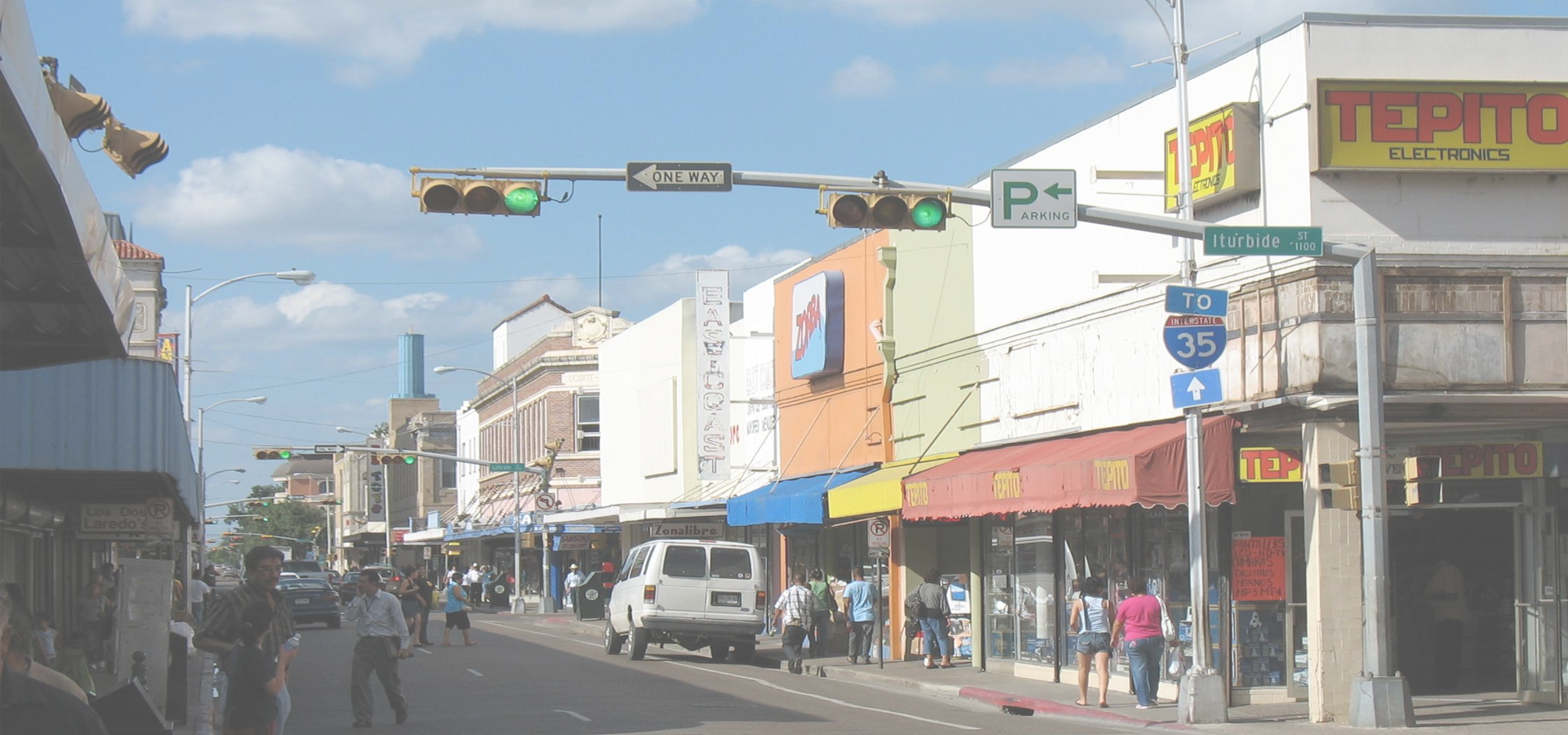
🇺🇸 Laredo is a city in and the county seat of Webb County, Texas, United States, on the north bank of the Rio Grande in South Texas, across from Nuevo Laredo, Tamaulipas, Mexico. Laredo has the distinction of flying seven flags. Founded in 1755, Laredo grew from a village to the capital of the brief Republic of the Rio Grande to the largest inland port on the Mexican border. Laredo's economy is based on international trade with Mexico. Many major transportation companies have a facility in Laredo. The city is on the southern end of I-35, which makes it close to the manufacturers in northern Mexico. It has four international bridges and one railway bridge.
The city is the 10th-most populous city in Texas and third-most populated U.S. city on the Mexican border, after San Diego, California, and El Paso, Texas. Its metropolitan area is the 178th-largest in the U.S. and includes all of Webb County. Laredo is also part of the cross-border Laredo–Nuevo Laredo Metropolitan Area.
Laredo is notable for its high Hispanic proportion, which at over 95%, is the highest proportion of Hispanic Americans out of any city in the United States outside of Puerto Rico. Because of this, it is one of the least ethnically diverse cities in the United States. When economic, household, and social diversity are considered, Laredo is the 19th-least diverse of the 313 largest cities in the nation.
Texas A&M International University and Laredo College are in Laredo. Laredo International Airport is within the Laredo city limits, while the Quetzalcoatl International Airport is nearby in Nuevo Laredo on the Mexican side.
The biggest festival, Washington's Birthday Celebration, is held during the later part of January and the majority of February, attracting hundreds of thousands of tourists.
History The Spanish colonial settlement of Villa de San Agustín de Laredo was founded in 1755 by Don Tomás Sánchez de la Barrera, while the area was part of the Nuevo Santander region in the Spanish viceroyalty of New Spain. Villa de San Agustín de Laredo was named after Laredo, Cantabria, Spain and in honor of Saint Augustine of Hippo. In 1840, Laredo was the capital of the independent Republic of the Rio Grande, set up in opposition to Antonio López de Santa Anna; it was brought back into Mexico by military force.
In 1846 during the Mexican–American War, the town was occupied by the Texas Rangers. After the war, the Treaty of Guadalupe-Hidalgo ceded the land to the United States. A referendum was taken in the town, which voted to petition the American military government in charge of the area to return the town to Mexico. When this petition was rejected, many who had been in the area for generations, moved across the river into Mexican territory, where they founded Nuevo Laredo. Many others, especially original land grantees on the north side of the Rio Grande remained, becoming Texans in the process. In 1849, the United States Army set up Fort McIntosh (originally Camp Crawford). Laredo was rechartered as a city in 1852.
Laredo is one of the oldest crossing points along the Mexico–United States border, and the nation's largest inland port of entry. In 2005, Laredo celebrated the 250th anniversary of its founding.
The etymology of the name for the Spanish town of Laredo is unclear. Some scholars say the name stems from glaretum, which means "sandy, rocky place". Others state Laredo stems from a Basque word meaning "beautiful pastures". Laredo might also stem from the Latin larida, which means gull.
Cellist Yo-Yo Ma brought his Bach Project to the Juarez–Lincoln International Bridge in April 2019.
Geography According to the United States Census Bureau, the city has a total area of 102.6 square miles (265.7 km²), of which 1.5 square miles (3.9 km²) (1.37%) are covered by water.
Geography: Location Laredo is on the west end of the Rio Grande Plains, south of the Edwards Plateau, west of the Coastal Plains, and east of the Mexican Mountains. The area consists of a few hills and flat land covered with grasses, oaks, and mesquite.
Bodies of water Notable geographic features are the Rio Grande and Chacon Creek's man-made reservoir, Lake Casa Blanca, in Lake Casa Blanca International State Park. The lake is 371 acres (1.5 km²) of land and 1,650 acres (7 km²) of water. The six major creeks are Chacon Creek, San Ildefonso Creek, San Ygnacio Creek, Santa Isabel Creek, Sombrerillito Creek, and Zacate Creek, all of which drain into the Rio Grande. Several man-made reservoirs include the San Ildefonso Creek Lake (second-largest reservoir), and the Sombrerillito Creek Lake (third-largest reservoir).
Nearby cities Nuevo Laredo, Tamaulipas 373,725 0 mi; Monclova, Coahuila 198,819 124 mi (200 km); Monterrey, Nuevo León 5,324,281 125 mi (201 km); Reynosa, Tamaulipas 589,466 130 mi (210 km); Corpus Christi, Texas 305,215 131 mi (211 km); San Antonio, Texas 2,601,788 154 mi (248 km); Heroica Matamoros, Tamaulipas 449,815 167 mi (269 km); Brownsville, Texas 183,046 170 mi (270 km); Saltillo, Coahuila 709,671 181 mi (291 km).
Demographics As of the 2020 United States census, 255,205 people, 72,328 households, and 58,294 families resided in the city.
As of the 2010, Laredo is the 81st-largest city in the United States and the 10th-largest in Texas. According to the 2010 census there were 236,091 inhabitants in the city.
According to the 2010 U.S. Census, the racial composition of Laredo was: • Whites: 87.7%, non-Hispanic Whites: 3.86% • Black or African American: 0.5% • Native American: 0.4% • Asian: 0.6% • Native Hawaiian and Other Pacific Islander: 0.00% • Two or more races: 1.5% • other races 9.3%
Ethnically, the city was: • Hispanic or Latino (of any race) – 95.6% (Mexican 86.9%, Puerto Rican 0.4%, Cuban 0.1%, other Hispanic or Latino 8.3%).
According to respondents' self-identification on the 2010 Census, the vast majority of Laredo's population is of Hispanic origin (95.6%), mostly Mexican (86.9%). Most Hispanics who did not identify themselves as Mexican identified as "other Hispanic or Latino" (8.3% of the total population). About 84.3% of the population identifies as white Hispanic, while only 11.3% identifies as Hispanic but not white; 4.4% of the population was not Hispanic or Latino (3.4% non-Hispanic White, 0.2% non-Hispanic Black or African American, 0.6% non-Hispanic Asian, 0.1% from some other race (non-Hispanic), and 0.1% of two or more races (non-Hispanic)).
The 2005 estimate listed 99,675 males and 108,112 females. The average household contained 3.69 occupants. The population density was 2,250.5 inhabitants per square mile (868.9/km²).
Of the 60,816 households, 56,247 or 92.5% were occupied: 33,832 were owner-occupied units and 22,415 were renter-occupied units. About 62.0% were married couples living together, 18.7% had a female householder with no husband present, and 14.7% were not families. Around 12.7% of all households were made up of individuals, and 5.2% had someone living alone who was 65 or older. The average household size was 3.69, and the average family size was 4.18.
The city's population is distributed as 35.5% under the age of 18, 11.4% from 18 to 24, 29.5% from 25 to 44, 15.8% from 45 to 64, and 7.8% who were 65 years of age or older. The median age was 27 years. For every 100 females, there were 92.2 males. For every 100 females age 18 and over, there were 87.2 males.
The median income for a household in the city was $32,019, and for a family was $32,577. The per capita income for the city was $12,269; 29.2% of families were below the poverty line.
According to the United States Census Bureau, at a 2000 census, Laredo was the second-fastest growing city in the United States, after Las Vegas.
In 2016, the violent crime rate in Laredo dropped to 379 per 100,000 inhabitants, according to AreaVibes. The violent crime rate in Dallas was 694 per 100,000 inhabitants. In Houston, it was 967 per 100,000 inhabitants.
Economy South Texas banking institutions in Laredo include Falcon International Bank, International Bank of Commerce, and Texas Community Bank.
Laredo is the largest inland port in the United States, and Nuevo Laredo the largest in Latin America. This is due to their respective locations, served by Interstate Highway 35 / Mexican Federal Highway 85, the effects of the North American Free Trade Agreement (NAFTA), dozens of twin assembly plants on the Mexican side, and dozens of import export agencies to expedite trade. In January 2014, the Laredo customs district processed "$20 billion in two-way trade with Mexico", about half that for the entire US with Mexico for the month. Laredo is a shopping destination for Mexican shoppers from Northern Mexico. In 2015 the San Antonio Express-News reported the number of Mexican shoppers has declined due to drug war-related violence in Nuevo Laredo.
Economy: Trade More than 47 percent of United States international trade headed for Mexico and more than 36 percent of Mexican international trade crosses through the Laredo port of entry. Laredo's economy revolves around commercial and industrial warehousing, import, and export. As a major player in international trade, the Laredo area benefited from passage of the North American Free Trade Agreement, which has encouraged trade. The Laredo port of entry consists of four international bridges (with a proposed fifth one) crossing the Rio Grande into the Mexican states of Tamaulipas and Nuevo León.
Economy: Retail Retail sales attract shoppers from Northern Mexico and South Texas. There is one indoor shopping mall in Laredo, Mall del Norte, The Outlet Shoppes at Laredo, and another has not progressed past planning: Laredo Town Center, part of downtown redevelopment. There are dozens of shopping centers. The Streets of Laredo Urban Mall is an association created by businesses on Iturbide Street in the San Agustin historical district to beautify and renovate the area, which has a pedestrian scale. • Mall Del Norte 1,198,199 sq ft (111,316.3 m²) • The Outlet Shoppes at Laredo, 380,000 sq ft (35,000 m²) owned by Horizon Group Properties, opened March 2017 with as many as seventy-seven stores, including Banana Republic, Tommy Hilfiger, Michael Kors, Brooks Brothers, OshKosh B'Gosh, Old Navy, New York and Company, and Kay Jewelers. • Streets of Laredo Urban Mall
Economy: Top employers United Independent School District, Education; Laredo Independent School District, Education; City of Laredo, Government; Laredo Sector Border Patrol, Immigration; H-E-B, Grocery; Webb County, Government; Laredo Medical Center, Health care; Texas A&M International University, Education; McDonald's, Food; Walmart, Retail; Concentrix (formerly Convergys), Call Center; Doctors Hospital, Health Care; International Bank of Commerce, Financial Services; Stripes Convenience Stores, Retail/Convenience; Laredo Energy Arena, Entertainment; Falcon International Bank, Financial Services.
Agriculture Laredo is a major centre for the cattle ranching in the state. Cattle here suffer from the cattle fever tick, Rhipicephalus microplus (syn. Boophilus microplus). Researchers and ranchers are concerned about pyrethroid resistance developing and spreading here, as it has in nearby areas of the state and neighboring Tamaulipas state. Because the situation is so severe, the main office of the country's Cattle Fever Tick Eradication Program is located here. This program is operated by USDA APHIS. The Deutch Strain of this tick was collected here by Davey et al., 1980 and is now a commonly used laboratory strain negative for pyrethroid resistance.
Annual celebrations The Washington's Birthday Celebration, a month-long event that celebrates George Washington's birthday, is the largest annual celebration of its kind in the United States, with 400,000 attendees. It was founded in 1898 by the Improved Order of Red Men, local chapter Yaqui Tribe No. 59. The first celebration was a success, and its popularity grew rapidly; in 1923, it received its state charter. In 1924, the celebration held its first colonial pageant, which featured 13 girls from Laredo, representing the 13 original colonies. The celebration includes parades, a carnival, an air show, fireworks, live concerts, and a citywide prom during which many of Laredo's elite dress in very formal attire. The related Jalapeño Festival is one of the United States' top 10 eating festivals.
Jamboozie is held in late January in downtown Laredo as part of the Washington's birthday celebrations. Similar to New Orleans' Mardi Gras, the Jamboozie is a colorful event, with many people dressed in beads, masks, and flamboyant outfits.
Culture: Museums The Republic of the Rio Grande Museum is in the downtown historical district next to the historic La Posada Hotel. What was once the Capitol building now showcases memorabilia from the short lived Republic of the Rio Grande. It displays pictures, books, and furniture from the 19th century Laredo area, and offers guided tours for school-aged children and adults year-round. Because of this Republic, Laredo had flown seven flags instead of the traditional Six Flags over Texas.
The Laredo Center for the Arts is located in downtown Laredo. The building houses three galleries: the Goodman Gallery, the Laredo Art League Gallery and the Lilia G. Martinez Gallery. The Center for the Arts, in the former City Hall offices known as "The Mercado", displays regional artwork and provides community events for children and adults. The Laredo Little Theater provides Laredo with live stage performances. The theater also hosts comedians.
Imaginarium of South Texas (formerly Laredo Children's Museum), in Mall del Norte, provides a hands-on experience with science, technology, and art for Laredo's youth. A second museum is planned on the Texas A&M International University campus.
The Nuevo Santander Museum Complex is composed of restored buildings of Fort McIntosh, a historical collection of photographs of the fort, the main guardhouse, which has World War I (1914–1918) memorabilia, and a science and technology museum.
Planetarium The Lamar Bruni Vergara Science Center Planetarium is on the Texas A&M International University campus. The planetarium surrounds audiences in a dome with an accurate image of the night sky showing all the motions and cycles of the Sun, Moon, planets, and constellations in the sky.
Library The Joe A. Guerra Laredo Public Library was first housed on the second floor of the City Hall, now known as the Market Hall, in 1916. In 1974, the Laredo Public Library moved to the historic Bruni Plaza in downtown Laredo. In 1993, the citizens of Laredo approved the construction of a new main library at McPherson and Calton Roads, which opened on February 1, 1998. The Laredo Public Library has a 60,000 sq ft (6,000 m²). main library and two branches. The main library is in central Laredo; the Bruni Plaza Branch is downtown east of Washington Street, and the Santo Niño Branch is in south Laredo.
Two new libraries opened in 2014, one in north-west Laredo, the Fasken Library on March 14, and another in the south sometime in July.
Churches and architecture Most of Laredo's architecture is of Spanish Colonial, American, and Mexican flavor. Most of Laredo's Spanish Colonial-style buildings are in downtown Laredo. More modern American architecture can be seen along Interstate Highway 35, as well as in the downtown area
Our Lady of Guadalupe is an imposing structure in Romanesque Revival Lombard (North Italian) style. It was designed by Leo M. J. Dielmann of San Antonio, a popular architect of Catholic buildings, and built for a Mexican-American and Hispanic congregation in the inner city, at San Jorge Avenue and Callaghan St. Dielmann was commissioned by church authorities to design churches for similar congregations in Houston and San Antonio. He also did the San Agustin parish school, and may have had a hand in the San Agustin church, itself.
Both the First United Methodist Church, in 1949, and the Christ Church Episcopal, were designed by Henry Steinbomer, a popular and prolific San Antonio architect who is credited with more than 100 churches and related buildings during the 1940s and 50s, from the Lower Rio Grande Valley mostly in South and West Texas, from the Sacred Heart Cathedral in San Angelo to Union Church in Monterrey, Mexico.
Other Laredo churches include Baptist, Presbyterian, Lutheran, Assembly of God, Mormon, and nondenominational congregations.
Historic Places • Barrio Azteca Historic District • Fort McIntosh • San Agustin de Laredo Historic District • Hamilton Hotel, architects Atlee B. Ayers and Robert Ayers, the tallest building in Laredo • U.S. Post Office, Court House, and Custom House • Webb County Courthouse, finished 1909 to designs in the Beaux-Arts style by renowned architect Alfred Giles.
Laredo in multimedia Streets of Laredo is a 1949 Western film starring William Holden, Macdonald Carey, and William Bendix as three outlaws who rescue a young girl, played by Mona Freeman. When they become separated, two reluctantly become Texas Rangers, while the third continues on a life of crime.
In 1958, ABC aired the second episode, "Ambush in Laredo", of the 17-part miniseries, Texas John Slaughter.
The 1959 Western film, Gunmen from Laredo, stars Robert Knapp, Walter Coy, Paul Birch, and Ron Hayes. He winds up in prison on a false murder charge, but the marshal allows him to escape to pursue the man who killed his wife.
The 1983 film Eddie Macon's Run, based on a James McLendon novel, features John Schneider as Eddie Macon, who is wrongly convicted of mostly minor crimes. While performing at a prison rodeo in Huntsville, Texas, he escapes and heads for Laredo, where he hopes to join his family in Mexico. Carl "Buster" Marzack (Kirk Douglas) is a cop in hot pursuit of Eddie. Without transportation, Eddie journeys on foot. He ends up in the woods, where he is nearly killed. He meets Jilly Buck (Lee Purcell), a bored rich girl who agrees to help him.
Lone Star is a 1996 American mystery film written and directed by John Sayles and set in a small town in Texas. The ensemble cast features Chris Cooper, Kris Kristofferson, Matthew McConaughey, and Elizabeth Peña and deals with a sheriff's investigation into the murder of one of his predecessors. The movie was filmed in Del Rio, Eagle Pass, and Laredo.
The 2011 series, Bordertown: Laredo, is a 10-episode documentary on the Arts and Entertainment Network based on the work of the narcotics unit of the Laredo Police Department.
Culture: Music Laredo has been the subject of several songs in popular culture. One of the most popular songs is the "Streets of Laredo", originally known as "A Cowboy's Lament" and written by Frank H. Maynard, who lived mostly in Colorado. It has been recorded by artists such as Johnny Cash, Marty Robbins, Waylon Jennings, John Cale, Roy Rogers, and Prefab Sprout (who also made a lyrical reference to Laredo in an early song, "Cue Fanfare"), and is even featured in a Charlie's Angels episode ("Pretty Angels all in a Row", season two, episode three). On October 28, 1958, in the episode "The Ghost" of the ABC/WB Western series, Sugarfoot, "The Streets of Laredo" is performed by child actor Tommy Rettig. Another song is Laredo Tornado from the British rock band ELO.
The first song on Marty Robbins' 1966 LP The Drifter was "Meet Me Tonight in Laredo".
From 1959 to 1972, the six-member singing group, The Rondels, dominated the musical scene in Laredo. Carlos Saenz Landin, the lead singer, left the group to work for the Dallas Independent School District, but years later returned to Laredo. Lead guitarist Humberto Donovan served in the United States Marine Corps. The late Roberto Alonzo played the bass guitar. Sammy Ibarra, played the keyboard and composed the song, "Lo Mucho Que Te Quiero (The More I Love You)". He subsequently became a pastor. Singer Noe Adolfo Esparza pursued a college career and became a supervisor for Southwestern Bell Telephone Company. As of 2017, he was still performing with the oldies group, Los Fabulosos in Laredo. Joe Lee Vera served in the United States Navy and played drums for The Rondels. Several of Vera's brothers were drummers too. The Rondels packed the Laredo Civic Center Auditorium. Two other songs characteristic of the group are "Ya-Ya" and "All Night Worker". With their disbanding, Juan Cisneros of Laredo recalls The Rondels "left a large void that will never be forgotten".
Sport: Laredo Heat The Laredo Heat is a United Soccer Leagues Premier Development League team. The team's home stadium is the Texas A&M International University Soccer Complex. The team was founded in 2004. In the 2006 season, the Laredo Heat finished runner-up, yet made it only to the first round of the Open Cup. In the 2007 season, the Laredo Heat were the Southern Conference champions and won the PDL championship. The Heat were on hiatus for the 2016 and 2017 seasons. In November 2017, the Heat announced they will be an expansion team of the National Premier Soccer League in 2018. The Heat recently announced they will also be joining the United Premier Soccer League for the 2020 season.
Tecolotes de los Dos Laredos The Tecolotes de los Dos Laredos (Owls of the Two Laredos) are a Mexican League baseball team based in Nuevo Laredo, Tamaulipas, Mexico. The team splits their home schedule between Parque la Junta in Nuevo Laredo and Uni-Trade Stadium in Laredo.
Laredo Honey Badgers The Laredo Honey Badgers were a proposed professional indoor soccer team that was founded in April 2013, expected to make its debut in the Professional Arena Soccer League with the 2013–2014 season. The team was to play its home games at the Laredo Energy Arena. The official name and colors (black and chrome) of the team were decided with fan participation. However, after several delays the team postponed its launch and eventually ceased operations.
Laredo Lemurs The Laredo Lemurs, a professional baseball team, played their first season in the independent American Association in 2012 with home games at Uni-Trade Stadium. They won the South Division in their inaugural season, but were eliminated in the first playoff round. The Lemurs won the league championship in 2015 but ceased operations after the 2016 season.
Laredo Roses The Laredo Roses were a professional women's full contact football team in the South Texas Sugar N Spice Football League that began play in the 2012 season. The Roses played their home games at the Uni-Trade Stadium. The female players used short-shorts and half-cut jerseys during games.
Laredo Swarm Laredo Swarm was a semi-professional basketball in the relaunched American Basketball Association. They started playing in 2015 in Laredo Energy Arena. The team was disbanded before the 2017–2018 season.
Sames Auto Arena The Sames Auto Arena is at US 59/Loop 20 and Jacaman Road. The arena was strongly pushed to fruition by former Laredo Mayor Betty Flores and was home to the former Laredo Bucks. The 178,000-square-foot (16,500 m²), $36.5 million facility seats 8,002 people for ice hockey and arena football, and up to 10,000 for concerts. It has fourteen luxury suites, four meeting rooms and a private club for two hundred charter members. It was completed in mid-2002 through an increase in the Laredo sales tax of.25 percent. Sports that can be played in the arena include ice hockey, arena football, indoor soccer, basketball, wrestling, and boxing. The arena has hosted many events such as The Laredo Hunting and Fishing Show, Miss Texas USA, Laredo Home and Garden Show and the South Texas Collectors Exp's Comic Con. Every year, Laredo College, TAMIU, United ISD and Laredo ISD have their graduation ceremonies here. Well-known artists and bands that have performed in the arena include Lil Wayne, Rihanna, Kesha, Pitbull, Flo Rida, Shakira, Enrique Iglesias, Tool, Aerosmith, Kiss, Elton John, Styx, REO Speedwagon, ZZ Top, Lynyrd Skynyrd, Ricky Martin, George Lopez, T.I., Ludacris, Cher, Hilary Duff, Monster Jam, and WWE.
Uni-Trade Stadium The Uni-Trade Stadium is Laredo's newest baseball field. The stadium is near the Laredo Energy Arena. The project was approved by the city council and was voted in favor of (with 61.32% of the votes in favor 38.68% against) constructing it with money collected since 2004 by a.25 percent sales tax increase. There is a surplus of about $15 million. The stadium was home to the Laredo Lemurs of the independent American Association from 2012 to 2016. Beginning in 2018, the Tecolotes de los Dos Laredos of the Mexican League play half of their home games at the stadium and the other half at Estadio Nuevo Laredo.
Student Activity Complex United Independent School District's students use the Student Activity Complex on State Highway 359 for football, soccer, and baseball. Opened in the summer of 2002, it has the city's first artificial grass stadium. The SAC was also the home of the Laredo Heat. The capacity is 8,500 spectators.
Texas A&M International University Soccer Complex Texas A&M International University Soccer Complex (also known as Dustdevil Field and TAMIU Soccer Complex) was built in 2006 and renovated in 2007. The soccer complex is on the Texas A&M International University campus. The complex has two soccer stadiums with a seating capacity of four thousand each. The Dustdevil Field is the new home stadium to the 2007 champion team Laredo Heat member of the United Soccer Leagues Premier Development League (PDL) and the TAMIU Dustdevils women and men's soccer teams member of the Lone Star Conference, NCAA Division II.
Shirley Field The original Shirley Field was next to the Civic Center and R&T Martin High School on San Bernardo Avenue. It was built in 1937, along with Martin High School. Shirley Field was the location for outdoor athletics for Laredo Independent School District and also hosts the annual Border Olympics events. It seats up to about 6,000 fans with additional seating at the 2 endzones. Professional Mexican soccer teams have played various exhibition games here, noting the real grass allows for "better" soccer games. The various sports played on the stadium are football, soccer and track & field events. Major renovations are slated for this historic stadium. In November 2009 Shirley Field was demolished and was rebuilt by the 2011 football season. The total cost of the reconstruction was $12,000,000 and it now seats 8,000 fans and features artificial turf.
Krueger Field Krueger Field is in north Laredo and is owned by United Independent School District. The stadium has a capacity of 5,000 and is used to play football and soccer high school games. It is home to United High School's football and soccer teams.
Veterans Field Veterans Field is a 5,000 seat baseball park which was known as West Martin Field. Major renovation is happening to update the 1950 ball park. Veterans Field was also the home to the five-time champion Mexican Baseball League team Tecolotes de los Dos Laredos from 1985 to 2003. Veterans Field is also home to the Texas A&M International University's Lone Star Conference NCAA Division II Dustdevils baseball team.
Laredo Civic Center Prior to the construction of the Laredo Energy Arena most major concerts and shows were performed at the Laredo Civic Center. The Laredo Civic Center complex has an auditorium with 1,979 seats and a banquet and exhibit hall with 1,635 seats.
Lake Casa Blanca Lake Casa Blanca International State Park, on US 59/Loop 20, has a 1,680-acre (680 ha) artificial lake along with cooking out, camping, picnicking, lake swimming, skiing, boating, and mountain biking. The most popular recreational use of the lake is fishing. A boat ramp and fishing pier is available on the lake's eastern side. The lake is a popular destination for winter Texans. The park was operated by the City of Laredo and Webb County before it was acquired by the state in 1990 and opened in March 1991.
Golf Laredo has three 18-hole golf courses: the Laredo Country Club, the Casa Blanca Golf Course. and Laredo's newest course Max A. Mandel Municipal Golf Course. The Laredo Country Club is an 18-hole private course with 7,125 yards (6,515 m) of golf. The golf course has a rating of 74.6, a slope rating of 133, and has a par of 72. The country club was designed by Joseph S. Finger and was opened in 1983. The Casa Blanca Golf Course is an 18-hole course with 6,590 yards (6,030 m) of golf. The golf course has a rating of 72.5, a slope rating of 125, and has a par of 72. The golf course was designed by Leon Howard and was opened in 1967. The Max A. Mandel Municipal Golf Course is an 18-hole course with 7,200 yards (6,600 m) of golf. The golf course has a par of 72. The golf course was designed by Robert Trent Jones II Golf Course Architects and was opened in 2012.
Parks, recreational centres, plazas, and baseball fields The City of Laredo owns eight recreational centres, thirty-four developed parks, twenty-two undeveloped parks or under construction, five baseball fields, and four plazas. The parks total area is 618 acres (2.50 km²).
David B. Barkley Plaza A memorial honoring the forty-one Hispanic soldiers who have received the Medal of Honor was built in Laredo, Texas in 2002. The plaza was named after the only Laredo Medal of Honor recipient David B. Barkley. The David B. Barkley Plaza has a bronze statue of David B. Barkley and an American flag measuring 100 ft by 50 ft and is 308 ft tall making it the tallest flagpole in the United States. The memorial is at 27°30′22″N 99°30′8″W.
Government The Laredo city government is a strong city council – weak mayor system. The mayor presides over the eight-member city council, but only votes to break a tie. City Council elections are based on single-member districts and campaigns have no party affiliations. Municipal elections are now held in November (formerly in May) of even-numbered years. The municipal government is administered by the city manager hired by the city council. All city elected offices have a four-year term and are nonpartisan though most officials have a Democratic party preference or affiliation.
City council meetings are held on Mondays and can be viewed on the public-access television cable TV channel or live online at Public Access Channel live stream.
Laredo was ranked #232 by the Nomad List which evaluates and ranks remote work hubs by cost, internet, fun and safety. Laredo has a population of over 262,491 people. Laredo also forms part of the wider Laredo-Nuevo Laredo metropolitan area which has a population of over 636,516 people. Laredo is the #366 hipster city in the world, with a hipster score of 2.0086 according to the Hipster Index which evaluates and ranks the major cities of the world according to the number of vegan eateries, coffee shops, tattoo studios, vintage boutiques, and record stores.
To set up a UBI Lab for Laredo see: https://www.ubilabnetwork.org Twitter: https://twitter.com/UBILabNetwork
Twin Towns, Sister Cities Laredo has links with:
🇲🇽 Acámbaro, Mexico 🇲🇽 Campeche, Mexico 🇲🇽 Cerralvo, Mexico 🇨🇳 Chenzhou, China 🇲🇽 Ciénega de Flores, Mexico 🇲🇽 Ciudad Valles, Mexico 🇲🇽 Cuernavaca, Mexico 🇲🇽 General Escobedo, Mexico 🇲🇽 General Terán, Mexico 🇲🇽 Guadalajara, Mexico 🇲🇽 Guadalupe, Mexico 🇳🇿 Hutt, New Zealand 🇲🇽 Irapuato, Mexico 🇲🇽 Jerez, Mexico 🇨🇷 La Cruz, Costa Rica 🇲🇽 Lampazos de Naranjo, Mexico 🇪🇸 Laredo, Spain 🇲🇽 Lázaro Cárdenas, Mexico 🇲🇽 León, Mexico 🇲🇽 Los Herreras, Mexico 🇲🇽 Mexticacán, Mexico 🇲🇽 Monclova, Mexico 🇲🇽 Montemorelos, Mexico 🇦🇺 Murray Bridge, Australia 🇲🇽 Nuevo Laredo, Mexico 🇲🇽 Papantla, Mexico 🇦🇷 San Antonio de Areco, Argentina 🇲🇽 San Miguel de Allende, Mexico 🇹🇼 Tainan, Taiwan 🇲🇽 Tepatitlán de Morelos, Mexico 🇲🇽 Tijuana, Mexico 🇲🇽 Tlahualilo, Mexico 🇲🇽 Tonalá, Mexico 🇲🇽 Torreón, Mexico 🇲🇽 Veracruz, Mexico 🇨🇳 Wenzhou, China 🇨🇳 Wuwei, China 🇨🇳 Zixing, China🇧🇷 Florianópolis 27.592
🇳🇵 Siddharthanagar 27.5
🇲🇽 Ciudad Obregón 27.483
🇲🇽 Nuevo Laredo 27.483
🇺🇸 Fort Pierce 27.433
🇲🇽 Iguala de la Independencia -99.483
🇲🇽 Jalpan de Serra -99.467
🇲🇽 Ciudad Nicolás Romero -99.367
🇲🇽 Huixquilucan de Degollado -99.35
🇲🇽 Huixquilucan -99.35
🇲🇽 Tula de Allende -99.334
🇲🇽 Tepeji del Río de Ocampo -99.333
🇲🇽 Puente de Ixtla -99.323
🇲🇽 Nicolás Romero -99.3
🇲🇽 Chilpancingo de los Bravo -99.5
🇲🇽 Nuevo Laredo -99.5
🇲🇽 Chilpancingo -99.507
🇲🇽 San Mateo Atenco -99.533
🇲🇽 Tenancingo de Degollado -99.583
🇲🇽 Tenancingo -99.583
Locations Near: Laredo -99.4919,27.5104
🇲🇽 Nuevo Laredo -99.5,27.483 d: 3.1
🇺🇸 Rio Grande City -98.817,26.367 d: 143.7
🇺🇸 Eagle Pass -100.489,28.711 d: 165.4
🇲🇽 Piedras Negras -100.517,28.7 d: 166.2
🇲🇽 Ciénega de Flores -100.183,25.95 d: 186.6
🇲🇽 Salinas Victoria -100.3,25.967 d: 189.5
🇺🇸 Mission -98.323,26.214 d: 185
🇺🇸 Edinburg -98.161,26.299 d: 188.6
Antipodal to: Laredo 80.508,-27.51
🇲🇺 Port Mathurin 63.417,-19.683 d: 18071
🇲🇺 Mahébourg 57.7,-20.407 d: 17571.3
🇲🇺 Centre de Flacq 57.718,-20.2 d: 17563.8
🇲🇺 Rivière du Rempart 57.633,-20.05 d: 17548.9
🇲🇺 Goodlands 57.633,-20.033 d: 17548.2
🇲🇺 Curepipe 57.517,-20.317 d: 17549.7
🇲🇺 Vacoas-Phoenix 57.493,-20.3 d: 17546.7
🇲🇺 St Pierre 57.517,-20.217 d: 17545.3
🇲🇺 Moka 57.496,-20.219 d: 17543.4
🇲🇺 Quatre Bornes 57.479,-20.266 d: 17543.9