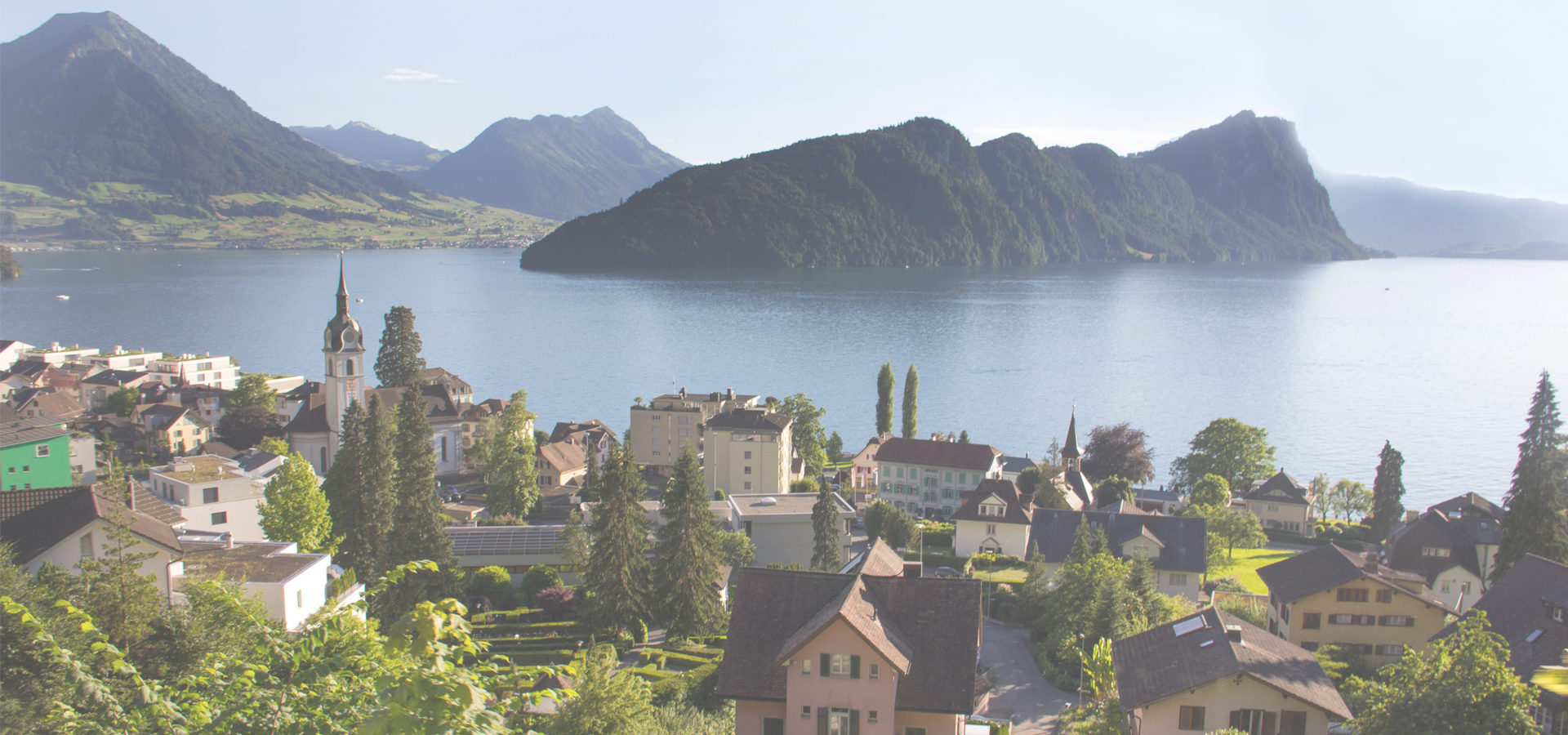
🇨🇭 Lucerne or Luzern is a city in central Switzerland, in the German-speaking portion of the country. Lucerne is the capital of the canton of Lucerne and part of the district of the same name. Lucerne is the most populous city in Central Switzerland, and a nexus of economics, transportation, culture, and media in the region. The city's urban area consists of 19 municipalities and towns. Owing to its location on the shores of Lake Lucerne and its outflow, the river Reuss, within sight of the mounts Pilatus and Rigi in the Swiss Alps, Lucerne has long been a destination for tourists. One of the city's famous landmarks is the Chapel Bridge, a wooden bridge first erected in the 14th century. The official language of Luzern is German, but the main spoken language is the local variant of the Alemannic Swiss German dialect, Lucerne German.
Demographics Lucerne has a population (as of 31 December 2021) of 82,771 As of 2021, 20,508 or 24.78% of the population was made up of foreign nationals, of which 18.22% are from Europe, 3.63% from Asia, 1.85% from Africa and 0.97% from America. Over the last 10 years the population has grown at a rate of 1.2%.
Most of the population (as of 2020) speak German (83.26%), with English with 7.45%, as well as Italian (5.06%) and Serbo-Croatian (3.80%) being respectively second, third and fourth most common first languages reported. Following, there are Portuguese (2.81%), Spanish (2.53%), Albanian (2.25%) and French (2.11%) language speakers.
The age distribution in Lucerne is (as of 2013); 12,916 people or 15.7% of the population is 0–19 years old. 26,381 people or 33.8% are 20–39 years old, and 25,863 people or 32.1% are 40–64 years old. The senior population distribution is 10,530 people or 13.1% are 65–79 years old, 4,208 or 5.2% are 80–89 years old and 900 people or 1.1% of the population are 90+ years old.
In Lucerne about 73.6% of the population (between age 25–64) have completed either non-mandatory upper secondary education or additional higher education (either university or a Fachhochschule).
As of 2000 there are 30,586 households, of which 15,452 households (or about 50.5%) contain only a single individual. 853 or about 2.8% are large households, with at least five members. As of 2000 there were 5,707 inhabited buildings in the municipality, of which 4,050 were built only as housing, and 1,657 were mixed use buildings. There were 1,152 single family homes, 348 double family homes, and 2,550 multi-family homes in the municipality. Most homes were either two (787) or three (1,468) story structures. There were only 74 single story buildings and 1,721 four or more story buildings.
Religion The city grew up around Sankt Leodegar Abbey, founded in AD 840, and remained strongly Roman Catholic into the 21st century. By 1850, 96.9% of the population was Catholic, in 1900 it was 81.9% and in 1950 it was still 72.3%. In the 2000 census the religious membership of Lucerne was: 35,682 (60%) Roman Catholic, 9,227 (15.5%) Protestant, with an additional 1,979 (3.33%) who were of some other Christian denominations; 1,824 individuals (3.07% of the population) Muslim; 196 individuals (0.33% of the population) Jewish. Of the remainder, 1,073 (1.8%) individuals were another religion; 6,310 (10.61%) stated they do not belong to any organized religion; and 3,205 (5.39%) did not answer the question.
Economy As of 2012, there were a total of 77,641 people employed in the municipality. Of these, a total of 166 people worked in 53 businesses in the primary economic sector. The secondary sector employed 7,326 workers in 666 separate businesses. Finally, the tertiary sector provided 70,149 jobs in 6,929 businesses.
Lucerne is home to a number of major Swiss companies, including Schindler Group, Chronoswiss, Emmi, EF Education First and the Luzerner Kantonalbank. Suva, one of Switzerland's oldest accident insurance companies, is also based in Lucerne, as is the University of Lucerne, the youngest of Switzerland's traditional universities.
Thanks to its continuous tax-cutting policies, Lucerne has become Switzerland's most business-friendly canton. As of 2012 Lucerne offers Switzerland's lowest corporate tax rate at cantonal level. Furthermore, Lucerne also offers very moderate personal income tax rates. In a recent published study of BAK Basel Economics taxation index 2012, Lucerne made it to the 4th place with an only marginally 2% higher tax rate compared to the top canton in this comparison.
Sights Since the city straddles the Reuss where it drains the lake, it has a number of bridges. These include the Chapel Bridge (Kapellbrücke), a 204 m (669 ft) long wooden covered bridge originally built in 1333, the oldest covered bridge in Europe, although much of it had to be replaced after a fire on 18 August 1993, allegedly caused by a discarded cigarette. Partway across, the bridge runs by the octagonal Water Tower (Wasserturm), a fortification from the 13th century. Inside the bridge are a series of paintings from the 17th century depicting events from Lucerne's history.
Downriver, between the Kasernenplatz and the Mühlenplatz, the Spreuer Bridge (Spreuerbrücke or Mühlenbrücke, Mill Bridge) zigzags across the Reuss. Constructed in 1408, it features a series of medieval-style 17th century plague paintings by Kaspar Meglinger (de) titled Dance of Death (Totentanzzyklus). The bridge has a small chapel in the middle that was added in 1568.
Old Town Lucerne is mainly located just north of the Reuss, and still has several fine half-timber structures with painted fronts. Remnants of the old town walls exist on the hill above Lucerne, complete with eight tall watch towers. An additional gated tower sits at the base of the hill on the banks of the Reuss.
The twin needle towers of the Church of St. Leodegar, which was named after the city's patron saint, sit on a small hill just above the lake front. Originally built in 735, the present structure was erected in 1633 in the late Renaissance style. However, the towers are surviving remnants of an earlier structure. The interior is richly decorated. The church is popularly called the Hofkirche (in German) and is known locally as the Hofchile (in Swiss-German).
Bertel Thorvaldsen's carving of a dying lion (the Lion Monument, or Löwendenkmal) is found in a small park just off the Löwenplatz. The carving commemorates the hundreds of Swiss Guards who were massacred in 1792 during the French Revolution, when an armed mob stormed the Tuileries Palace in Paris.
The Swiss Museum of Transport is a large and comprehensive museum exhibiting all forms of transport, including locomotives, automobiles, ships, and aircraft. It is to be found beside the lake in the northern-eastern section of the city.
The Culture and Convention Center (KKL) beside the lake in the centre of the city was designed by Jean Nouvel. The centre has one of the world's leading concert halls, with acoustics by Russell Johnson.
The Richard Wagner Museum is found on the lake at Tribschen and is dedicated to the composer Richard Wagner. Wagner lived in Lucerne from 1866 to 1872 and his former villa now hosts the museum dedicated to him.
Culture Since plans for the new culture and convention centre arose in the late 1980s, Lucerne has found a balance between the so-called established culture and alternative culture. A consensus was reached that culminated in a culture compromise (Kulturkompromiss). The established culture comprises the Lucerne Culture and Congress Centre (KKL), the city theater (Luzerner Theater) and, in a broader sense, smaller establishments such as the Kleintheater, founded by comedian Emil Steinberger, a Lucerne native, or Stadtkeller, a music restaurant in the city's old town. KKL houses a concert hall as well as the Museum of Art Lucerne (Kunstmuseum Luzern).
Alternative culture took place mostly on the premises of a former tube factory, which became known as Boa. Other localities for alternative culture have since emerged in the same inner city area as Boa. Initially, Boa staged various plays, but concerts became more and more common; this new use of the building clashed with the development of apartment buildings on nearby lots of land. Due to possible noise pollution, Boa was closed and a replacement in a less heavily inhabited area is currently under construction. Critics claimed though that the new establishment would not meet the requirements for an alternative culture.
Südpol is a centre for performing arts in Lucerne presenting music-, dance- and theatre-events. The house at the foot of Pilatus opened in November 2008.
Lucerne is home to the Luzerner Sinfonieorchester, a category A symphonic orchestra, and to the 21st Century Symphony Orchestra, and they both hold most of their performances in the Lucerne Culture and Congress Centre.
Events Every year, towards the end of winter, Fasnacht (Carnival) breaks out in the streets, alleyways and squares of the old town. This is a glittering outdoor party, where chaos and merriness reign, and nothing is as it normally is. Strange characters in fantastic masks and costumes make their way through the alleyways, while Guggenmusiken (carnival bands) blow their instruments in joyful cacophony and thousands of bizarrely clad people sing and dance away the winter. Lucerne Fasnacht, based on religious, Catholic backgrounds, starts every year on the Thursday before Aschermittwoch (Ash Wednesday) at 5 am with a detonation called Urknall (Big Bang), the signal to begin the Tagwache (wake-up procession). There are big parades in the afternoon on Schmotzige Donnerstag (literally: Lardy Thursday) and the following Monday, called Güdismontag (literally: Paunch Monday), which attract tens of thousands of people. Lucerne's Carnival ends with a crowning finish on Güdisdienstag (literally: Paunch Tuesday) evening with the Monstercorso, a tremendous parade of Guggenmusiken, lights and lanterns with even a larger audience. Rather recently a fourth Fasnacht day has been introduced on the Saturday between the other Fasnacht days, the Rüüdige Samstag while mainly several indoor balls take place. From dusk till dawn on the evenings of Schmotzige Donnerstag, Güdismontag, and after the Monstercorso many bands wander through the historical part of the city playing typical Fasnacht tunes. Until midnight, the historical part of the city usually is packed with people participating. A large part of the audience are also dressed up in costumes, even a majority in the evenings.
The city hosts various renowned festivals throughout the year. The Lucerne Festival for classical music takes place in the summer. Its orchestra, the Lucerne Festival Orchestra, is hand-picked from some of the finest instrumentalists in the world. In June yearly the pop music festival B-Sides takes place in Lucerne. It focuses on international acts in alternative music, indie rock, experimental rock and other cutting edge and left field artistic musical genres. In July, the Blue Balls Festival brings jazz, blues and punk music to the lake promenade and halls of the Culture and Convention Center. The Lucerne Blues Festival is another musical festival which usually takes place in November. Since spring 2004, Lucerne has hosted the Festival Rose d'Or for television entertainment. And in April, the well-established comics festival Fumetto attracts an international audience.
Being the cultural centre of a rather rural region, Lucerne regularly holds different folklore festivals, such as Lucerne Cheese Festival, held annually. In 2004, Lucerne was the focus of Swiss Wrestling fans when it had hosted the Swiss Wrestling and Alpine festival (Eidgenössisches Schwing- und Älplerfest), which takes place every three years in a different location. A national music festival (Eidgenössiches Musikfest) attracted marching bands from all parts of Switzerland in 2006. In summer 2008, the yodelling festival (Eidgenössisches Jodlerfest) had a similar impact.
The 2021 Winter Universiade was planned to be hosted by Lucerne, but was cancelled due to the COVID-19 pandemic.
Transport After Ferdinand von Zeppelin landed his airship in Lucerne in 1909, the city became a pioneer for the aeronautical industry in Switzerland. In February 1910 the country's first (and after the DELAG of Germany the second in the world) air transport company was founded, in July the same year then also the first airship hangar at Tribschenmoos. The company provided flights with airships until 1914 without notable accidents.
Lucerne boasts a developed and well-run transport network, with the main operator, Verkehrsbetriebe Luzern (VBL), running both the trolleybuses in Lucerne and a motor buses network in the city and to neighboring municipalities. Other operators, such as PostAuto Schweiz and Auto AG Rothenburg, provide bus services to other towns and villages.
Lucerne is one of Switzerland's principal stations, and is well-connected to the rest of Switzerland via railway services operated by Swiss Federal Railways (SBB CFF FFS), the Südostbahn SOB, the BLS and the Zentralbahn (zb). There are 40 trains per day between Lucerne and Zürich, with an average travel time of 48 minutes. Zurich Airport can be reached in just over an hour. Adjacent to the station is Luzern Bahnhofquai, from which ships of the Lake Lucerne Navigation Company operate to various destinations on Lake Lucerne. Between April and mid October, the tourist oriented Gotthard Panorama Express connects Lucerne with Lugano once a day by boat and train, travelling by boat along the length of Lake Lucerne and then by train over the historic high-level Gotthard route.
Three other railway stations are located within the city boundaries, with Lucerne Allmend/Messe close to the Swissporarena in the south of the city, Luzern Littau in the former municipality of Littau and the Luzern Verkehrshaus adjacent to the Swiss Museum of Transport in the east.
Lucerne's city transit system is fully integrated into the coherent and integrated fare network system called passepartout encompassing all kind of public transport in the cantons of Lucerne, Obwalden, and Nidwalden.
A funicular, Gütschbahn, links the city to Château Gütsch, 90 m above. Standseilbahn Hotel Montana runs from the lakefront to Hotel Montana. From 1912 to 1978, there was Dietschibergbahn at Dietschiberg.
Sport There are several football clubs throughout the city. The most successful one is FC Luzern which plays in Switzerland's premier league (Swiss Super League). The club plays its home matches at the new Swissporarena, with a capacity of 16,800.
The city's main hockey team is the HC Luzern which plays in the Swiss Second League, the fourth tier of Swiss hockey. They play their home games in the 5,000-seat Swiss Life Arena.
In the past, Lucerne also produced national successes in men's handball and women's volleyball and softball.
Having a long tradition of equestrian sports, Lucerne has co-hosted CSIO Switzerland, an international equestrian show jumping event, until it left entirely for St. Gallen in 2006. Since then, the Lucerne Equestrian Masters replaced it. There is also an annual horse racing event, usually taking place in August.
Lucerne annually hosts the final leg of the World Rowing Cup on Rotsee Lake. Numerous World Rowing Championships have been held in Lucerne including the inaugural World Championships of 1962 and then the regattas of 1974, 1982 and 2001.
Lucerne hosts the annual Spitzen Leichtathletik Luzern track and field meeting, which attracts world class athletes such as Yohan Blake and Valerie Adams.
The city also provides facilities for ice-hockey, figure-skating, golf, swimming, basketball, rugby, skateboarding, climbing and more.
Lucerne hosted FIVB Beach Volleyball World Tour event Lucerne Open 2015 and FIVB Beach Volleyball U21 World Championship in 2016.
Lucerne has a population of over 82,771 people. Lucerne also forms the centre of the wider Lucerne Canton which has a population of over 416,347 people. Lucerne is ranked #366 for startups with a score of 0.664. It is estimated there are around 7,648 businesses in Lucerne.
To set up a UBI Lab for Lucerne see: https://www.ubilabnetwork.org Twitter: https://twitter.com/UBILabNetwork
Twin Towns, Sister Cities Lucerne has links with:
🏴 Bournemouth, England 🇺🇸 Chicago, USA 🇵🇱 Cieszyn, Poland 🇫🇷 Guebwiller, France 🇨🇿 Litovel, Czech Republic 🇫🇷 Murbach, France 🇨🇿 Olomouc, Czech Republic 🇩🇪 Potsdam, Germany🇩🇪 🇨🇭 Graphic/Poster Designer Polly Bertram is associated with Lucerne.
🇲🇩 Sectorul Buiucani 47.038
Locations Near: Lucerne 8.30801,47.0455
🇨🇭 Hochdorf 8.283,47.167 d: 13.6
🇨🇭 Affoltern am Albis 8.45,47.283 d: 28.5
🇨🇭 Unterkulm 8.117,47.317 d: 33.4
Antipodal to: Lucerne -171.692,-47.046
🇹🇴 Nuku'alofa -175.216,-21.136 d: 17116.6
🇹🇴 Nukuʻalofa -175.2,-21.133 d: 17116.5
🇦🇸 Pago Pago -170.701,-14.279 d: 16370.5
🇼🇸 Apia -171.76,-13.833 d: 16322
🇵🇫 Papeete -149.566,-17.537 d: 16159.9
🇺🇸 Pāhoa -154.946,19.494 d: 12428.2
🇺🇸 Hilo -155.089,19.725 d: 12406.2
🇺🇸 Maui -156.446,20.72 d: 12326.3
🇺🇸 Maui County -156.617,20.868 d: 12313.5