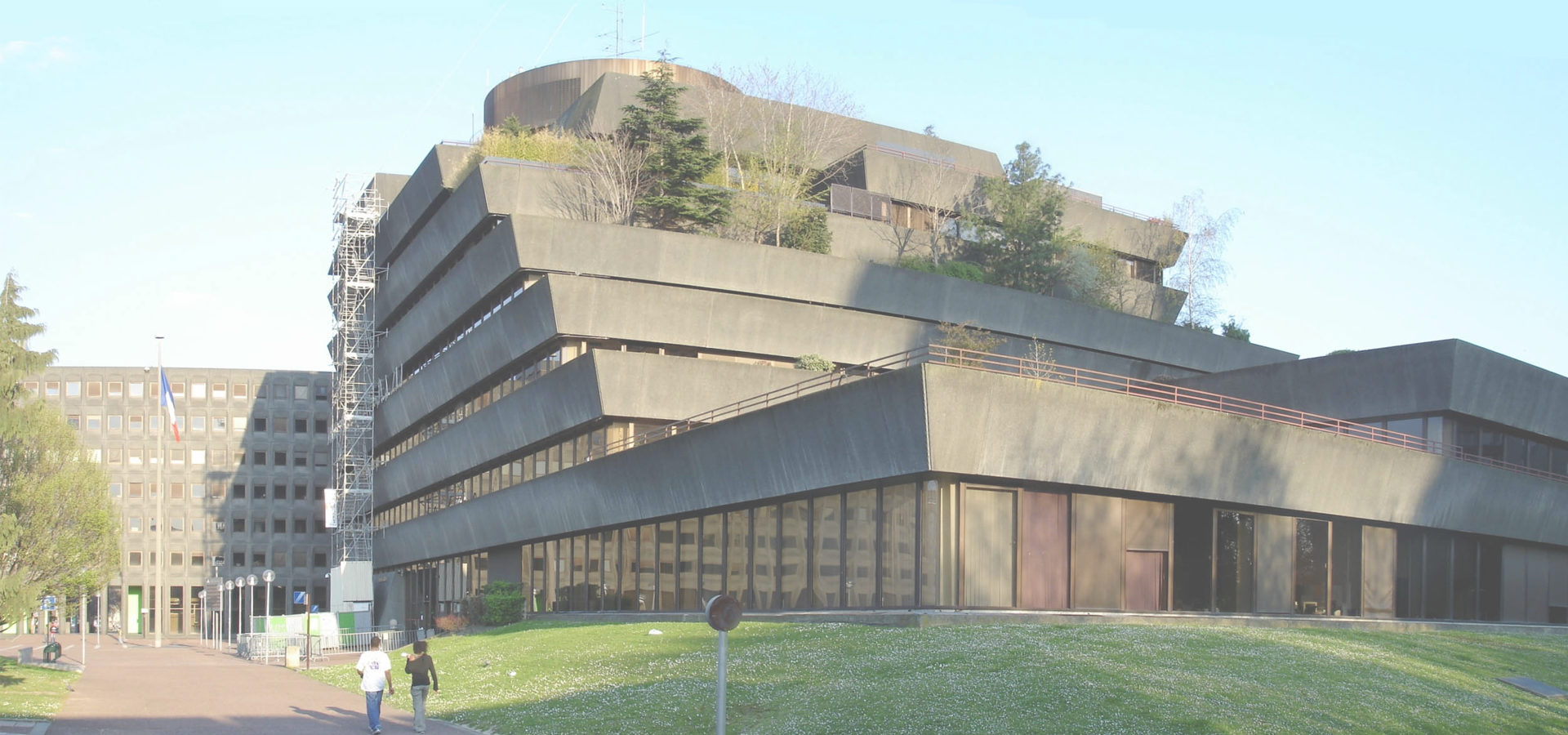
Aubervilliers, Seine-Saint-Denis Département, Île-de-France Region, France

Geography | Transport : Public | Urbanism | Toponymy | History : Middle Ages | From the Renaissance to the 18th century | French Revolution and Empire | From the Restoration to the Paris Commune | The Belle Époque to the Second World War | Contemporary period | Administration | Economy | Civil heritage | Religious heritage | Education | Hospitals and clinics | Sport | Culture : Theatre | Cinema | Libraries | Arts

🇫🇷 Aubervilliers is a commune in the Seine-Saint-Denis department in the Île-de-France region in the north-eastern suburbs of Paris, France.

Geography Aubervilliers is one of three communes in the Plaine Saint-Denis, 7.2 km (4.5 mi) north-east of the centre of Paris. The Canal Saint-Denis traverses the commune on the western side from north to south.

Transport Aubervilliers is a commune close to Paris and has numerous means of transport including: the A86 autoroute from L'Ile-Saint-Denis in the west to Drancy in the east with Exit 9 on the northern border of the commune, Route nationale N301 from Stains in the north and joining the Paris ring road in the south, the D20 from Gennevilliers in the west, the D27 from Bobigny in the east, and the D115 from Pantin in the south-east. The Paris ring road is just outside the southern border of the commune and there are two access routes to it: by the Porte d'Aubervilliers and by the Porte de la Villette. These roads provide easy access to the network of roads and motorways around Paris as well as Le Bourget and Charles de Gaulle airports.

The Canal Saint-Denis once had important river ports and there was the Paris-Hirson railway and an industrial railway for Saint-Denis/Aubervilliers which served the Plaine Saint-Denis.

Transport: Public The RER railway passes through the north of the commune and the station of La Courneuve-Aubervilliers, located just north of the commune on the N301 road, serves Aubervilliers. There are also two Metro stations on the south-western border on Avenue Jean-Jaures: Aubervilliers-Pantin-Quatre Chemins at the corner of Ave. de la Republique, and Fort d'Aubervilliers at the corner of Ave. de la Division Leclerc.

The commune is served by: • Paris Métro Line 7 : stations Aubervilliers-Pantin-Quatre Chemins and Fort d'Aubervilliers; • Sixteen bus routes: RATP Bus:  35   134   139   150   152   170   173   234   239   249   250   302   330   512  Noctilien: N42 N43; • Gare de La Plaine-Stade de France: as far as Saint-Denis and Aubervilliers; • Gare de La Courneuve - Aubervilliers: located in La Courneuve commune about 1 km to the north of the commune border. • Paris Métro Line 12 since 18 December 2012 with the opening of the Front Populaire station and ultimately, in May 2022, it got extended to Mairie d'Aubervilliers station, with 1 intermediate stop at Aimé Césaire station. • Ligne 3b of the Île-de-France tramway since 15 December 2012 with the opening of the Porte d'Aubervilliers located in the Paris area near the commune.

Urbanism Aubervilliers is an urban commune, as it is one of the dense or intermediate density communes, as defined by the Insee communal density grid. It belongs to the urban unit of Paris, an inter-departmental conurbation comprising 407 communes and 10,785,092 inhabitants in 2017, of which it is a suburban commune.

The commune is also part of the functional area of Paris where it is located in the main population and employment centre of the functional area. This area comprises 1,929 communes.

Urban morphology The main quarters or districts of the commune are: • Quatre-Chemins; • Quarante-Cinq at La Villette; • Maladrerie (and its 800 lodgings which form a Sensitive urban zone or ZFU); • Pont-Blanc/Vallès/Hemet (the agglomération is called Vallès la Frette); • Landy (split between Aubervilliers and Saint-Denis); • Cité Crèvecœur (Crèvecœur Housing Estate); • Cité du 112 (112 Housing Estate); • Cité République (official name) (République Housing Estate); • Sadi-Carnot; • Les Presles; • Cité Heurtault (Heurtault Housing Estate); • Les Fleurs; • Cité Gabriel-Péri (Gabriel-Péri Housing EState); • Les Fusains; • Square of roses; • Le fort.

Toponymy The town is mentioned in the Latinised form Albertivillare in 1059. It is from this that the inhabitants are known as Albertivillarien.

The place name of -villiers (a variant of -villier, -villers, -viller, coming from the Low Latin villare, derived from villa - progressively meaning "farm", "village", then "town") is a characteristic appellative for agricultural domains in the Merovingian and Carolingian periods. The first part is the Germanic personal name Adalbertus from which are derived the names Albert (English form) and Aubert (French form) and also became a surname. It is homonymous with a hamlet in Seine-et-Marne, Aubervilliers, and Auberville in Normandy (the others are explained by the Old Norse personal name Osbern giving Auber, the name of a Norman family).

History As with many communes in the outer suburbs the town had long been a rural area. Formerly known as Notre-Dame-des-Vertus, the village was on a plain which produced the best vegetables around Paris.

History: Middle Ages Aubervilliers first appears in the archives in 1059 as Albertivillare, meaning "estate of Adalbert". In the following year Henry I donated it to the Priory of Saint-Martin-des-Champs. In 1111 the serfs were freed in Aubervilliers. In 1182 the priory of Saint-Martin-des-Champs, located in Paris, granted Paris butchers the right to freely graze their cattle in the fields after the harvest was over. In 1221, Guillaume Bateste, lord of Franconville, became the first Lord of Vivier les Aubervilliers. The church, which at the beginning of the 13th century depended on one of the parishes of Saint Denis, soon became famous for the miraculous appearance of an image of the Virgin.

In 1336 Father Jacques Du Breul, Prior of the Abbey of Saint-Germain-des-Prés, reported the Miracle of the rain: A young girl busy preparing flowers to adorn the statue of the Virgin in the church saw her face streaming with tears when the rain began to fall on the parched crops. In 1338 King Philip VI of France and his queen went to Aubervilliers to visit the image. From 1340 to 1792 people went there in droves each year from Paris and its surroundings. In 1402 Michel de Laillier, Lord of Ermenonville, became Lord of Vivier les Aubervilliers. In 1429 the town was occupied by the English but was retaken by Michel de Laillier in 1436. Louis XI went there in November 1474 to the house of Pierre L’Orfèvre, the new Lord of Vivier from then until August 1478. The image of the Virgin in lead that the king wore on his hat was a representation of the one at Aubervilliers.

In 1531 the Lordship of Vivier les Aubervilliers was sold to the Montholon family which held it until 1779. The facade and tower of the church were built in the reign of Henry II. Civil wars which the Armagnacs stirred up in France led to the destruction of the village but the abundant alms of the many pilgrims who came from all sides allowed a prompt reconstruction. On 10 November 1567 the Battle of Saint-Denis took place in the Plaine Saint-Denis between the Catholic army of Anne de Montmorency and the Protestant troops of the Prince of Condé.

Henri IV stayed in Aubervilliers during the Siege of Paris in 1590.

From the Renaissance to the 18th century The visit by Louis XIII in 1613, then again in 1614 and 1628, allowed the development of pilgrimage to Notre-Dame des Virtues. Jacques Gallemant, pastor of Aubervilliers, allowed a community of Oratorians to settle in Aubervilliers in 1618. They took charge of the Church of Notre-Dame-des-Vertus and developed an important pilgrimage around the statue of the Virgin of Aubervilliers. The installation from 1622 of a "House of Notre-Dame des Vertus" by the Oratorians of John de Bérulle then its progressive extension throughout the 17th century made Aubervilliers an important centre of French Catholic spirituality. Thinkers, "pious and famous faithful" such as Francis de Sales, Vincent de Paul, John Eudes (he stayed for two years), Jean-Jacques Ollier, Jean-Baptiste de La Salle, the philosopher Nicolas Malebranche, and the son of the great Jean Racine - the poet Louis Racine participated in a pilgrimage there and returned. At the end of the 17th century and in the first half of the 18th century, the House of Oratorians of Aubervilliers became a "stronghold" of the Jansenist dissent.

In 1649, during the Fronde, Aubervilliers fell into misery. Crops were destroyed, death reigned and population declined. There were 125 deaths in 1652 in a population of about 1,500 inhabitants. Nevertheless, the small town was reborn although until the 19th century it was populated by farmers. Proximity to the Paris markets promoted Market gardening, especially on the Plain of Vertus which was famous for its onions and a wide range of vegetables. The existence of the Mazier farm at 70 Rue Heurtault is attested by a document in 1699.

French Revolution and Empire On 12 August 1787 the first meeting of the Municipal Assembly of Aubervilliers took place. In 1789 there was a list of grievances, complaints and remonstrances written by Mesme Monard, the parish priest, and one of the leaders against the Oratorians. On 24 January 1790 the election of the first mayor of Aubervilliers took place: Nicolas Lemoine was elected. In 1792 the boundary of the commune of Aubervilliers was delineated.

During the Napoleonic Wars, the Plain of Aubervilliers was, in 1814 and 1815, the scene of a bloody battle between French troops and the Prussians who took and re-took it several times. The French soldiers were overpowered by numbers and were eventually forced to abandon it.

From the Restoration to the Paris Commune On 13 May 1821 the Canal Saint-Denis opened. In 1832, an outbreak of cholera decimated the population. In 1840 a factory was set up to manufacture soap from resin. The Fort d'Aubervilliers was built in 1843 - it was part of the Thiers wall, a structure authorised in 1840 by Adolphe Thiers to protect Paris and, where appropriate, to subdue its rebellions forming an elongated belt around Paris. It was used for the repression of the Paris Commune. The grounds of the fort and its surroundings are part of Aubervilliers commune. In 1861 the Central Market was created.

On 1 January 1860, the city of Paris was enlarged by annexing neighbouring communes. On that occasion, a small part of the commune of Aubervilliers was annexed to the city of Paris. At the same time, the commune of La Chapelle-Saint-Denis was disbanded and divided between the city of Paris, Aubervilliers, Saint-Denis, and Saint-Ouen. Aubervilliers received a small part of the territory of La Chapelle-Saint-Denis.

The Industrial Revolution and the expansion of Paris radically changed the situation in Aubervilliers. Industries were established next to the canal. On 6 October 1862 Baron Hainguerlot began the operation of General Stores in Saint-Denis. In 1866 he moved to Aubervilliers. In 1866 Saint-Gobain purchased a factory manufacturing sulphuric acid from John Frédéric Boyd which was located on Rue du Landy. On 12 September 1867 Lady Lequin began operating a Match factory at a place called La Motte, Rue du Vivier.

During the Siege of Paris in 1870 the municipal government took refuge in Paris at 20 Boulevard de Strasbourg. At the beginning of 1877 a tramway arrived in the city centre. In 1879, the boyauderie (Tripe factory) owned by Mr. Jacquart was established. It was later purchased by Witt SA, a boyaudier from La Courneuve. The whole complex was bought in 1921 by the Wanner establishment who manufactured insulating materials: ceramic, plaster, and cork tiles. On 18 June 1897 a grease manufacturing factory (industrial oils and greases) was established on Chemin Haut de St Denis at Aubervilliers and remained in operation until the Second World War. In 1898 a tram depot was built at the corner of the Avenue de la République No. 30 and Rue du Midi.

The Belle Époque to the Second World War At the end of the 19th century the life of the small town was already closely linked to nascent industrialization. People from Belgium, Lorraine, Alsace, Brittany, Spain, and Italy arrived in successive waves. This capacity to absorb and mix populations is characteristic of the history of the commune. Workers come to live in the suburbs which were cheaper than in Paris. Ever since Aubervilliers has been a multicultural city where more than 70 nationalities live.

For decades major industries shaped the identity of the city.

The district of Quatre-Chemins, which straddles the boundary of Aubervilliers and Pantin, was pejoratively nicknamed La Petite Prusse (Little Prussia) due to many immigrants coming to work in the Saint-Gobain glassworks - established in 1866 next to the canal. The identity of the district led them to ask in vain for the status of full-function commune at the end of the 19th century.

Summary of events • 15–16 April 1900: the burning of the church. • 1908: installation of the Edmond Jean Enamel works. • 1923: Pierre Laval became mayor of Aubervilliers, up until 1944. • 1927: Construction of the main post office on Rue Achille-Domart. • 1929: Construction of 186 cheap housing units and 4 shops by the Société Anonyme d'HBM d'Aubervilliers on avenue Jean-Jaurès, opposite the Fort. • 1931: Construction of 110 cheap housing units and 4 shops by l’Office public d’HBM d’Aubervilliers, Rue de la Goutte d'Or and Rue Bordier. Work on the Auguste Delaune Municipal Stadium ends. • 1944: the Leclerc division is stationed on Route nationale 2. Charles Tillon becomes mayor.

Contemporary period • 1948: Construction of 142 housing units at Pont Blanc. • 1953: Mayor Charles Tillon resigns, Émile Dubois replaces him; 19 April: construction by the HLM Group of Prés Clos; 14 July: delivery of the Ethel and Julius Rosenberg Estate on Avenue du President Roosevelt. • 18 July 1954: construction of 37 housing units at 37 Rue des Grandes-Walls. • 1957: following the death of Mayor Émile Dubois, André Karman becomes mayor. • 1958: Construction of the Gabriel-Peri Estate. • 15 May 1965:, delivery of the Maurice Thorez Estate at 21 rue des Cités. • 1969: construction of the République Estate located at 64-68 Avenue de la République. • On the night of 1 and 2 January 1970 five Africans were found dead in a migrant workers residence from asphyxia due to an improvised heating system. This drama has a strong impact and gave rise to a lively debate on immigration and living conditions in the migrant workers' residences. Despite a call for privacy at the funeral on 10 January, there was an eruption of demonstrators by the Gauche prolétarienne (Proletarian Left) and people such as Kateb Yacine, Jean-Paul Sartre, and Michel Rocard. The Aubervilliers slum was visited two days later by Prime Minister Jacques Chaban-Delmas, followed by a controversial televised debate on 14 January on Les Dossiers de l'écran. This drama made a lasting impression on the representation of immigration in the French collective imagination. • 1972:, the Aubervilliers Slum on the Chemin de Halage along the canal near Stains bridge completely disappeared. • 1974: The Tour La Villette is an example of contemporary architecture. • 1978: Renovation of the Maladrerie district. • 1979: Inauguration of the Paris Métro stations of Aubervilliers-Pantin-Quatre Chemins and Fort d'Aubervilliers. • 1984: On the death of Mayor André Karman Jack Ralite becomes mayor.

The construction of the Stade de France (Stadium of France) just north of the commune in 1998 was a stimulating element in the Saint-Denis Plain. With its 750 hectares on the outskirts of Paris, The Saint-Denis Plain covers one third of Aubervilliers and extends over Saint-Denis and Saint-Ouen. Since the early 2000s this area, which was one of the largest industrial areas in Europe, has been changing and should receive the Campus Condorcet in the late 2010s.

In 2014, the commune has been awarded "two flowers" by the National Council of Towns and Villages in Bloom in the Competition of cities and villages in Bloom.

The Franco-Chinese Friendship Association stated that from November 2015 to August 2016 over 100 ethnic Chinese in Aubervilliers had been robbed. 49-year old Chaoling Zhang (张朝林 Zhāng Cháolín), beaten in a robbery, died on August 16, 2016.

Administration Until the law of 10 July 1964 the commune was part of the department of Seine. The redistribution of the former departments of Seine and Seine-et-Oise resulted in the commune becoming part of Seine-Saint-Denis after the administrative transfer effective from 1 January 1968.

Aubervilliers is the only commune of the canton of Aubervilliers, created in 2015. It is one of the 9 communes of the arrondissement of Saint-Denis.

Economy In economic terms Aubervilliers is the fourth largest city in the department of Seine-Saint-Denis with 30,000 jobs and 2,444 businesses in the private sector.

The city has a dense network of SMEs representing 25% of employment. These SMEs include research laboratories such as Rhodia and Saint-Gobain, large public institutions such as Orange S.A., Documentation française, transport services such as La Poste, and the workshops of La Villette such as the Paris Métro and a large RATP bus depot.

77% of available jobs are today in services, transport, and retailing. Industrial activities are present with companies such as lampes Aric, Thyssen elevators, Messier-Bugatti-Dowty, and Vesuvius plc. Headquarters and administrative departments of large firms have also established here: Rhodia, KDI, Motul, Lapeyre-GME, and Zurich Insurance).

New industries have developed in recent years including: Telecommunications: (TelecityGroup, Interxion, Completel, etc.) and telematic services (Atos, FNAC Direct, Acticall, etc.); Audiovisual and Cinema: (Euromédia, Carrere Group, Studios d'Aubervilliers, Ciné-Lumières, Téléshoping, NPA, etc.); Textiles and fashion (Kookai, Redskins, Hugo Boss, Afflelou, etc.)

Another sign of this change has been the strengthening of wholesale and import-export activities. With more than 300 establishments concentrated in the Entrepôts et Magasins généraux de Paris (Warehouses and General Stores of Paris) (EMGP) and also around the Port of Aubervilliers (district of La Haie-Coq), this sector is a new business area in strong development. Haie-Coq imports are cheap manufactured goods of all kinds (textiles, watches, toys, decoration, gadgets), usually from Chinese products, which distributed throughout France. The CIFA - Fashion Business Center is the centre of this business.

Civil heritage • The Old Match Factory (1904) at 124 rue Henri-Barbusse (now Documentation française) is registered as a historical monument. • The Maladrerie District: Renée Gailhoustet conceived the master plan for the Maladrerie District for a thousand housing units where there was previously a "quasi-slum". The land area of 9 hectares was urbanised in ten phases from 1975 to 1984 under the supervision of the architects Magda Thomsen, Vincent Fidon, and Yves and Luc Euvremer with the concept of a mainly continuous pedestrian space and varied sizes of buildings in relation to the existing low-rise buildings. As well as Green roofs, patios, and neat gardens, the project increased the number of covered walkways and service roads for the inhabitants which was at odds with the HLM stereotypes for construction and without reference to dividing into City blocks. In addition to a retirement home, offices, shops, a childcare centre, and a socio-cultural centre (Espace Renaudie), there are artists' studios which were not anticipated at the outset. • Le Corbusier School, 1997–2003, expanded and rebuilt by the architect Pierre Riboulet. • The Tower La Villette • Fort d'Aubervilliers • The Hôtel de Ville (town hall) contains the following items that are registered as historical objects: • Two decorative panels in the Hall of Commissions, depicting Abundance & Peace and Work (1928 & 1931) • Painting: Allegory of the Liberation (1945).

Religious heritage • The Church of Notre-Dame-des-Vertus (16th century) is registered as a historical monument. The church is the old centre of Aubervilliers and it was built on a rectangular plan like a covered market. The vault of the nave is decorated with a keystone representing the Virgin. The bell tower was erected in 1541 under François I and the facade of the building in 1628 when Louis XIII decided to build in the Jesuit style to express his gratitude to the Virgin after his victory over the Protestants. The church contains many items which are registered as historical objects: • Statue: Virgin and Child (17th century) • Statue: Virgin and Child (19th century) • The Stained glass windows were blown out by an explosion in the gunpowder factory in La Courneuve fort on 15 March 1918 and they were redone by the Charles Champigneulle workshop. Many of them represent the miracles of Our Lady of Virtues. They are registered as three objects: • 3 Stained glass windows (Bays 3, 4, and 16) (20th century) • 13 Stained glass windows (Bays 1, 2, and 5 to 16) (20th century) • Stained glass window (St. Jacques & St. Christophe) (19th century) • Reliquary and 2 Statues (19th century) • Painting: Saint Mary of the Incarnation (19th century) • Pedestal Organ (1780) The organ with musical instruments (1770–80) was the work of François-Henri Clicquot and is the only Iles-de-France instrument of the 17th century in the department. It was restored in 1990 by the organ builders Robert Chauvin, Louis Benoist, and Pierre Sarelot. The inauguration of the restoration took place in 1990 with organist Michel Chapuis and countertenor Daniel Delarue. • Instrumental part of the Pedestal Organ (1780) • Painting with frame: Christ in the garden of olives (18th century) • 2 Statues: Angels adoring (16th century).

Education Aubervilliers has 14 kindergartens, 15 elementary schools, 5 collèges (middle schools), and 4 lycées (high schools). The city also has three private establishments and several specialized institutions. The collèges (middle schools) include Diderot, Rosa Luxemburg, Jean Moulin, Gabriel Péri, and Henri Wallon. The lycées include Lycée Polyvalent D'Alembert, Lycée d'enseignement général et technologique Le Corbusier ("Le Corbusier High School of General and Technological Education"), Lycée professionnel Jean-Pierre Timbaud ("Jean Pierre Timbaud Vocational High School"), and Lycée d'enseignement général et technologique Henri Wallon ("Henri Wallon High School of General and Technical Education").

Schools and colleges in Aubervilliers • Fort School (multi-lingual private School) • Babeuf School • Robespierre School • Françoise Dolto School • Jules Guesde School • Victor Hugo School • Jean Jaurès School • Jean Macé School • Joliot-Curie School • Edgar Quinet School • Paul-Langevin School • Wangari Maathai School • Notre-Dame-des-Vertus School • Maximilien-Robespierre School • Stendhal School • Jules-Vallès School • Eugène-Varlin School • Taos Amrouche School • Charlotte Delbo School • Marc Bloch School • Angela Davis School • Anne Sylvestre School • Pierre Brossolette • Saint-Just School • Jean-Jacques Rousseau School • Paul Bert School • Jean Perrin School • Francine Fromond School • Gerard Philippe School • Jacques Prévert School • Louise Michel School • Kehilat-Chne-Or Jewish School • Maria Cesarès Inter-communal School • Diderot College • Rosa-Luxembourg College • Jean-Moulin College • Gabriel-Péri College • Saint-Joseph College (Private college) • Henri-Wallon General and Technological College and School • Réussite Islamic General and Technological College and School • D’Alembert Universal School • Le-Corbusier General and Technological School • Jean-Pierre-Timbaud Vocational School

Hospitals and clinics • La Roseraie European Hospital of Paris • Henri Duchêne Centre • Clos Bénard Hospital • l’Orangerie Centre for Medical and Surgical Consultations • Aubervilliers Polyclinic

Sport • Athletics C.O.A. • Athletics CMA • Aikido • Badminton, Auber'Bad • Basketball (AABB) • Bodybuilding • Boules Lyonnaises • Bridge • Canoeing Outdoors CMA • Chess • Climbing Outdoors CMA • Créole Relay sports and leisure of Aubervilliers • Municipal Cycling of Aubervilliers 93 • Cycle-tourism • Dance - Ballroom, Auber • Dance - Caribbean, Colibri des Iles • Dance - Handicap • Dance - Hip-Hop, Ethnix Dream • Dance - Oriental (ACAS) • Dance - Salsa • Diving CMA • English Boxing - Boxing Beats • Fencing • Flash Boxing of Auber. Thai boxing • Football A.S.J.A. • Football F.S.G.T. • Football, F.C.M.A. • Gymnastics Sportive CMA • Handball CMA • Hiking • Indans'Cité • Judo, Jujitsu CMA • Karaté club of Aubervilliers • Karaté for all • Kung-fu Boxing Club • Long-distance running • MMA Fitness Centre • OMJA • Paintball Challenge • Pétanque (Casanova) • Pétanque (Gabriel Péri) • Pétanque (Théâtre) • Physical Culture CMA • Qwan Ki Do • Swimming CMA • Top Forme Women's Gym • Table tennis • Tennis • Totof Muay Thaï • Volleyball relaxation Aubervilliers • Yoga and Wellness • Youth Sports Association of Aubervilliers (ASJA)

Culture: Theatre • The Theatre of the Commune was one of the first national drama centres established in the suburbs for more than thirty years. It is now run by Didier Bezace who in 2005 received two Molière Awards including for the staging of the play La Version de Browning. • The Zingaro Equestrian Theatre is headed by Bartabas and is established at Fort d'Aubervilliers.

Cinema • Le Studio Cinema occupies in the same building as the theatre. It is classified as an Arthouse (Art et Essai) and has, in addition to its regular programmes, a Festival pour éveiller les regards (Festival to raise eyes) aimed at young people.

Libraries • Aubervilliers has four libraries, including André Breton, Paul Eluard, Henri Michaux, and Saint-John Perse.

Arts • The Espace Jean-Renaudie is a visual arts centre (Capa) in the Maladrerie district. • The Métafort d'Aubervilliers is located at 4 Avenue de la Divion Leclerc. • The Laboratoires d'Aubervilliers offers residencies for artistic research projects in dance, visual arts, theatre, cinema, and interdisciplinary projects. It is located at 41 Rue Lecuyer. • The Villa Mais d’Ici is a cultural centre to promote small cultural businesses. It is located at 77 Rue des Cités. • The Regional Conservatory of music, theatre, and dance of Aubervilliers-La Courneuve has been run since 1974 in partnership with La Courneuve. It trains 1,400 students in musical, voice, theatre and dance disciplines. Opera productions are mounted regularly, providing an important partnership with schools and cultural organisations in the department and Ile-de-France.

Europe/Paris/Seine-Saint-Denis 
<b>Europe/Paris/Seine-Saint-Denis</b>
Image: Clicsouris

Aubervilliers has a population of over 87,570 people. Aubervilliers also forms one of the centres of the wider Saint-Denis Arrondissement which has a population of over 435,309 people. It is also a part of the larger Seine-Saint-Denis Département.

To set up a UBI Lab for Aubervilliers see: https://www.ubilabnetwork.org Twitter: https://twitter.com/UBILabNetwork

Twin Towns, Sister Cities Aubervilliers has links with:

🇵🇸 Beit Jala, Palestine 🇲🇷 Bouly, Mauritania 🇩🇪 Jena, Germany
Text Atribution: Wikipedia Text under CC-BY-SA license

Antipodal to Aubervilliers is: -177.617,-48.913

Locations Near: Aubervilliers 2.3831,48.9131

🇫🇷 Pantin 2.402,48.897 d: 2.3  

🇫🇷 St. Denis 2.354,48.936 d: 3.3  

🇫🇷 Saint-Denis 2.354,48.936 d: 3.3  

🇫🇷 Saint-Ouen-sur-Seine 2.334,48.911 d: 3.6  

🇫🇷 Bobigny 2.435,48.914 d: 3.8  

🇫🇷 Buzenval 2.402,48.852 d: 6.9  

🇫🇷 Paris 2.352,48.857 d: 6.7  

🇫🇷 Drancy 2.45,48.93 d: 5.2  

🇫🇷 Noisy-le-Sec 2.45,48.889 d: 5.6  

🇫🇷 Clichy 2.306,48.904 d: 5.7  

Antipodal to: Aubervilliers -177.617,-48.913

🇹🇴 Nuku'alofa -175.216,-21.136 d: 16919.1  

🇹🇴 Nukuʻalofa -175.2,-21.133 d: 16918.7  

🇦🇸 Pago Pago -170.701,-14.279 d: 16112.3  

🇼🇸 Apia -171.76,-13.833 d: 16077.6  

🇵🇫 Papeete -149.566,-17.537 d: 15709.1  

🇺🇸 Hilo -155.089,19.725 d: 12062.9  

🇺🇸 Maui -156.446,20.72 d: 11992.5  

🇺🇸 Maui County -156.617,20.868 d: 11981  

🇺🇸 Wailuku -156.505,20.894 d: 11975.3  

🇺🇸 Kahului -156.466,20.891 d: 11974.5  

Bing Map

Option 1