Guntur, Andhra Pradesh, India
🇮🇳 Guntur is a city and the administrative headquarters of Guntur district in the Indian state of Andhra Pradesh. Guntur city is the 24th most densely populated city in the world and 11th in India. The city forms a part of the Andhra Pradesh Capital Region. The city is known for its chilli, cotton and tobacco exports and has the largest chilli market in Asia. It is a major transportation, education and commercial hub for the state.
Guntur city is a municipal corporation and also the headquarters of Guntur East and Guntur West mandals in Guntur revenue division. The city region is a major part of Amaravati Metropolitan Region. As of 2011 census of India the city is the third most populous in the state. It is classified as a Y-grade city as per the Seventh Central Pay Commission. It is the 24th most densely populated city in the world and 11th in India.
1Etymology In Sanskrit documents, Guntur was referred to as Garthapuri; in Telugu, "Guntlapuri" means "a place surrounded by water ponds". The settlement might have been near a pond (Telugu: "gunta"); hence "gunta uru" means "pond village". Another source refers to "kunta", a land-measuring unit, which may have transformed to "kunta uru" and later to "Guntur".
1History The region was historically known for Buddhism; the first Kalachakra ceremony was performed by Gautama Buddha. Agastyeshwara temple is one of the oldest temples in the city; according to a local legend, Agastya built it in the Treta Yuga around a swayambhu linga. Inscriptions on the side of Naga Muchalinda, a sculpture unearthed in 2018 in the compound of the temple, are in Naga Lipi, an ancient script from the third century CE. Based on this discovery, Emani Sivanagi Reddy, archaeologist and Buddhist scholar believes this region served as a Buddhist site contemporary to Nagarjunakonda.
The earliest reference to Guntur is found in inscriptions by Ammaraja I (922–929 CE), the Vengi Chalukyan king. According to an inscription in Sri Narasimha Swami temple at Ramachandra Agraharam, Tirumala Dasa Mahapatra—the local ruler of the Gajapathi king Kapileswara Gajapathi—gave donations to the temple of Mulastha Mallikarjuna Deva in 1485 CE.
Prior to the British Raj, Guntur has been ruled by the Satavahanas, Andhra Ikshvakus, Vishnukundinas, Pallavas, Vengi Chalukyas, Kakatiya kings, Reddy kings, Gajapathi kings, and Vijayanagar kings, Nizams of Hyderabad, French India, and the British East India Company. The British East India Company took over the Kondaveedu Fort in 1788 and abandoned it in the early 19th century in favour of Guntur, which was made the headquarters of a district named after it. The district was abolished in 1859 and reconstituted in 1904.
The city rapidly became a major market for agricultural produce from the surrounding countryside due to the opening of the railway link in 1890. The expansion continued post independence as well and was concentrated in what is now called New Guntur, with many urban areas such as Brodipet, Arundelpet and suburban areas like Pattabhipuram, Chandramoulinagar, Sitaramanagar, and Brindavan Gardens. In 2012, the city limits were expanded with the merger of surrounding ten villages, namely Nallapadu, Pedapalakaluru, Ankireddipalem, Adavitakkellapadu, Gorantla, Pothuru, Chowdavaram, Etukuru, Budampadu and Reddypalem.
The High Court was setup in Guntur when Andhra State was formed. It was moved to Hyderabad after the formation of Andhra Pradesh. After the bifurcation of the state a new High Court is set up in the capital region of the residual state near Guntur.
Guntur is the place of discovery of helium they discovered this in 1869 from observations of the solar eclipse of 18 August 1868 by the French astronomer Pierre Janssen. Allen Olliver Becker's family from Guntur was among the survivors of the Titanic ship disaster.
1Geography Guntur is located at 16.29°N 80.43°E. It has an average elevation of 33 metres (108 ft) and is situated on the plains. There are few hills in the surrounding suburban areas and Perecherla Reserve Forest is located in the city's north-west. Guntur lies approximately 30 km (19 mi) south of Amaravati, the capital of Andhra Pradesh.
1Demographics Based on the 2011 Census of India, after a merger of nearby villages in 2012, Guntur had a population of 743,354. The 2023 estimate of the city population is 9,81,000. It is classified as a Y-grade city under the Seventh Central Pay Commission.
Based on the 2011 census data prior to the city's expansion in 2012, Telugu is the most-widely spoken language with 545,928 native speakers, followed by 109,574 Urdu speakers. A significant minority speak Hindi, Odia and Tamil. The religious demographic consists of 522,030 Hindus (77.91%), 120,974 Muslims (18.05%), 21,787 Christians (3.25%), 2,312 Jains (0.35%) and 2,605 (0.82%) did not state any religion. One of the supposedly lost tribes of Israel called Bene Ephraim has a presence in Guntur; there is a Jewish synagogue at Kothareddypalem near Chebrolu.
1Governance The city's local authority is Guntur Municipal Corporation (GMC), which at over 150 years old, is one of India's oldest municipalities. It was constituted in 1886, when the city had a population of 25,000; the city was upgraded to a third-grade municipality in 1891, a first-grade municipality in 1917, a special-grade municipality in 1952, and a selection-grade municipality in 1960. In 1994, Guntur was upgraded as a municipal corporation and its first local election was held in 1995. The city is divided into 57 revenue wards. During the financial year 2018–19, the corporation had a budget of ₹1,004 crore (equivalent to ₹13 billion or US$150 million in 2023).
Guntur is one of thirty-one cities in the state to be a part of water-supply-and-sewerage-services mission known as Atal Mission for Rejuvenation and Urban Transformation (AMRUT). The city was certified as open defecation free as part of Swachh Bharat Mission. In the 2023 Swachh Survekshan rankings, Guntur was ranked fourth in India, rising from its ranking of 129th in 2018.
Guntur is the headquarters of Guntur East and Guntur West mandals in Guntur revenue division. The city is a major part of Andhra Pradesh Capital Region Development Authority. It is represented in the federal government by Guntur Lok Sabha constituency, and at state level by Guntur East and Guntur West assembly constituencies.
1Other offices As part of the Andhra Pradesh Capital Region, Guntur houses many state offices and agencies such as Andhra Pradesh Forest Department and the Agricultural Marketing Department, and regional office of the Crime Investigation Department. The AP State Judicial Preview offices are located at Nagarampalem. Guntur group of the National Cadet Corps is located at Syamalanagar. The city also hosts an Indian Army recruitment and training centre. The city's passport office was opened in 2018.
1Healthcare, utilities and policing Guntur has several urban healthcare centres and about 200 private hospitals, including several specialty centres. The Government General Hospital (GGH) is the city's main tertiary healthcare provider.
The city's main source of drinking water is Guntur Channel, which draws water from the Krishna River. An extension of this channel is being planned to increase coverage of the city and the capital region. Summer storage tanks are located in Sangam Jagarlamudi, and Vengalayapalem reservoir is the other source of water to the city. The city's electricity is provided by Andhra Pradesh Southern Power Distribution Company Limited (APSPDCL).
Guntur police uses surveillance and central monitoring control systems with high-resolution cameras at important traffic junctions.
1Economy The GDP per capita of Guntur City is $ $8,786.
The city forms a part of the East Coast Economic Corridor, an important industrial corridor in the country. It hosts many state offices and agencies, being part of the district capital and being in close proximity to the state legislative capital Amaravati. The city is about 1100 miles south of the national capital New Delhi. Guntur is known for its chilli, cotton and tobacco exports and has the largest chilli market yard in Asia. The city region is surrounded by many ancient temples and sites that include Kondavidu, Amararama, Caves, Pedakakani.
The major commercial and residential areas in the city include the Arundelpet, Lakshmipuram and Brodipet. Koretapadu, Navabharath Nagar, Pattabhipuram, Syamala Nagar and Vidya Nagar etc., are some of the other areas in the city. Autonagar, Gorantla, Pedapalakaluru, Nallapadu, Budampadu, Chowdavaram etc. are some of the other areas of the city.
The city has many parks, museums, temples, nature conservation sites, forts, resorts and caves. The Jinnah Tower is one of the iconic structure on Mahatma Gandhi Road, one of the important centres of the city. There are seventeen parks in the city with some of them maintained by the municipal corporation. Larger city parks like Nagara-Vanam are being developed on the outskirts of the city. There are many places to visit nearby the city such as Uppalapadu Bird Sanctuary, Kondaveedu Fort etc. There are many festivals and events in the region such as beach festivals, hill festivals attract the city residents during various festival seasons. The closest beach to the city region is Surya Lanka.
1Economy The city is headquarters to Agricultural Marketing Department. The Tobacco Board, The Spices Board also has their headquarters located in the city. Agriculture Market Committee Market Yard, the largest chilly yard of Asia, generates an income of up to ₹100 crore (US$13 million) during trading season. The spiciest Guntur chillies are exported to foreign countries and the city stands second in terms of trade, next to Mexico. Commercial activities are concentrated mostly on outlets such as, cinema halls, malls, jewelry, fertilisers. There are also several spinning mills on the outskirts of the city.
1Culture Residents of Guntur are referred as Gunturians. Cultural events with focus on literature and poetry are regularly organised. Venkateswara Vignana Mandiram and Annamaiah Kalavedika are popular venues for cultural programs. In 2021, a new venue called Gurram Jashua Kala Pranganam was being constructed. The city observes many festivals such as Rama Navami, Hanuman Jayanthi, Maha Shivaratri, Vinayaka Chavithi, Vijaya Dasami, Deepawali, Holi, Ugadi, Eid, Krishnastami, Christmas, Karthika Pournami.
1Cityscape The major commercial and residential areas in the city include Arundelpet, Lakshmipuram and Brodipet. Other major areas of the city are Koretapadu, Navabharath Nagar, Pattabhipuram, Syamalanagar and Vidyanagar, Autonagar, Gorantla, Pedapalakaluru, Nallapadu, Budampadu and Chowdavaram.
Jinnah Tower on Mahatma Gandhi Road is a rare monument related to Muhammad Ali Jinnah, founder of Pakistan, in India. Guntur has 17 parks, some of which are maintained by the municipal corporation. Nagaravanam, a part of Perecherla Reserve Forest, was developed on the outskirts of the city as a park.
Tourist attractions in Guntur include the Sri Ganga Parvathi Sametha Agastheswara Temple. In the old city, notable sites include Gandhi Park, the Baudhasree architectural museum, Nagaravanam, and NTR Manasa Sarovaram. Nearby ancient temples and heritage sites include the Amareswaraswamy temple, Undavalli Caves, Sri Bramarambha Malleswara Swamy Temple at Pedakakani, and Kondaveedu Fort. The Uppalapadu Bird Sanctuary is located 10 km (6.2 mi) from the city, while Suryalanka Beach is approximately 60 km (37 mi) away.
Agastheswara Sivalayam, situated in Guntur’s old city, is a temple devoted to Lord Shiva. It holds historical significance with inscriptions in the ancient "Naga Lipi" script, dating back to 1100 AD. The temple is among the most well-known in the region. According to local legends, the sage Rishi Agastya constructed the temple during the Treta Yuga, centered around a naturally occurring Swayambhu Linga, which led to the temple's name. Constructed in the early 20th century, Jinnah Tower is a notable monument in Guntur dedicated to Muhammad Ali Jinnah, the founder of Pakistan. This impressive heritage structure features six pillars and an open dome, showcasing typical architectural styles of Muslim design from that era. Strategically located on Mahatma Gandhi Road, one of the city's main arterial road, the tower serves as a symbol of peace and harmony, reflecting the secular values embraced by the local community.
1Environment In 2019, pollution levels in Guntur city were at a moderate level when compared with other major cities. There have been many efforts to increase awareness and keep the city clean, including a 100-day cleanup drive in 2021. A plastic-waste-to-fuel conversion plant was set up in the city; fuel from the plant was used for vehicles run by the GMC.
The GMC started using electric vehicles for domestic garbage collection in 2021. E-auto rickshaws were introduced in the city to reduce air and noise pollution; many electric charging stations have been set up across the city for this purpose. Efforts to reduce plastic use in the city and replace it with environment-friendly materials like jute, paper and cloth have been made.
In 2021, United Nations Human Settlement Program planners recommended implementation of larger parks, mass transit with metro trains and electric bus systems, and improvements to city expansion plans.
1Transport Local transport in Guntur includes privately operated auto rickshaws, taxi cabs, minibuses and government-run APSRTC buses. Auto rickshaws operating on a sharing basis are the cheapest form of transport for students and workers. NTR bus station and an adjacent minibus station accommodate more than 2,000 buses every day, about half of them from depots in the erstwhile united district. Plans for e-Bus Bay centres in the city were proposed in 2021.
1Transport: Road The city has a total of 893.00 km (554.88 mi) of roads. Mahatma Gandhi Inner Ring Road is a 6.34-kilometre (3.94 mi) arterial road that starts on National Highway 16. The inner ring road, along with Guntur Bypass, and sections of national and state highways, encircles the city. The arterial city roads include Grand Trunk Road, JKC College Road, Lakshmipuram Road, Pattabhipuram Road and Palakaluru Road. The GMC identified Amaravati Road, Lalapuram Road, Medical Club Road, Chuttugunta Road and Palakaluru Road for double-laning, and many other roads for widening to accommodate traffic.
National highways (NH), state highways (SH) and major district roads pass through Guntur. NH16, part of Asian Highway 45 and Golden Quadrilateral with Guntur Bypass connects to Chennai and Kolkata on the east coast of India. NH167A and SH2 connect Guntur with Macherla and Hyderabad. NH544D connects Guntur with Anantapur and towards Bengaluru on NH44. SH48 connects Guntur with the coast through Bapatla and Chirala. Major district roads link Guntur with Amaravati, Nandivelugu, Tenali, Mangalagiri, and Parchur.
1Transport: Rail Guntur's main railway stations are Guntur Junction, Nallapadu and New Guntur. Stations at Namburu, Perecherla and Pedakakani Halt serve as satellite stations. MEMU and local train services between Guntur and Vijayawada are used by thousands of university students and public. The Rail Vikas Bhavan at Pattabhipuram is the headquarters of Guntur railway division. Guntur railway station is well connected with Vijayawada and Tenali railway stations.
1Transport: Air Vijayawada international airport, the nearest airport to Guntur, is 54 km (34 mi) away.
1Education Primary and secondary education is provided by government and private schools. Aided schools were either transferred to government or became private in 2020 as per a government mandate. According to the school information report for the academic year 2021-22, more than one lakh, thirty thousand (130,000) students were enrolled in over 450 schools in the city and about 695,476 students are enrolled in the schools in the district. The medium of instruction in municipal corporation schools was switched to English from the year 2016-2017.
The public library system in Guntur is supported by the government and the district central library is located at Arundalpet. Annamayya library was set up with 1 lakh books that were donated by bibliophile Lanka Suryanarayana.
Hindu College and Andhra Christian College were established during the British Raj for higher education. Jagarlamudi Kuppuswamy Chowdary College, RVR & JC College of Engineering, Tellakula Jalayya Polisetty Somasundaram College (TJPS College), Government College for Women and St. Joseph's College of Education for Women are autonomous colleges.
Guntur Medical College is one of the oldest medical colleges in the state. Several higher education institutes such as Vignan's Foundation for Science, Technology & Research, Katuri Medical College, All India Institute of Medical Sciences, Mangalagiri, Acharya Nagarjuna University and Acharya N. G. Ranga Agricultural University have campuses near the city.
A regional Agmark laboratory, and a regional station of the Central Tobacco Research Institute of the Indian Council of Agricultural Research are located in Guntur. The city hosts many national, and state-level conferences and expos on the economy, agriculture and technology.
1Media Eenadu, Sakshi and Andhra Jyothi are the most-popular Telugu daily newspapers in terms of circulation in the united Andhra Pradesh and the top-three Telugu news sites. The newspapers Surya and Vaartha are published from Guntur. The Hindu, The New Indian Express, The Hans India and Deccan Chronicle are a few of the English-language daily newspapers that are circulated in Guntur.
1Sport Sporting infrastructure in Guntur includes Brahmananda Reddy Stadium for tennis, badminton, volleyball, athletics, and gymnastics; and NTR Municipal Indoor Stadium for table tennis and volleyball. A swimming pool is proposed to be added to Brahmananda Reddy Stadium and a boxing ring is being planned for NTR municipal stadium.
Guntur has hosted sporting events such as the All India Senior Tennis Association, the All India Sub Junior Ranking Badminton Tournament, the All India Invitation Volleyball Tournament, the Ganta Sanjeeva Reddy Memorial Trophy and the Inter-district Master Aquatic Championship. The city was also a host for the Khelo India programme for junior-level national sports in 2016. The city hosts mini-marathons and 10 km (6.2 mi) walks. International sports personalities from Guntur include cricketer Ambati Rayudu and badminton player Srikanth Kidambi.
1Guntur, Andhra Pradesh, India
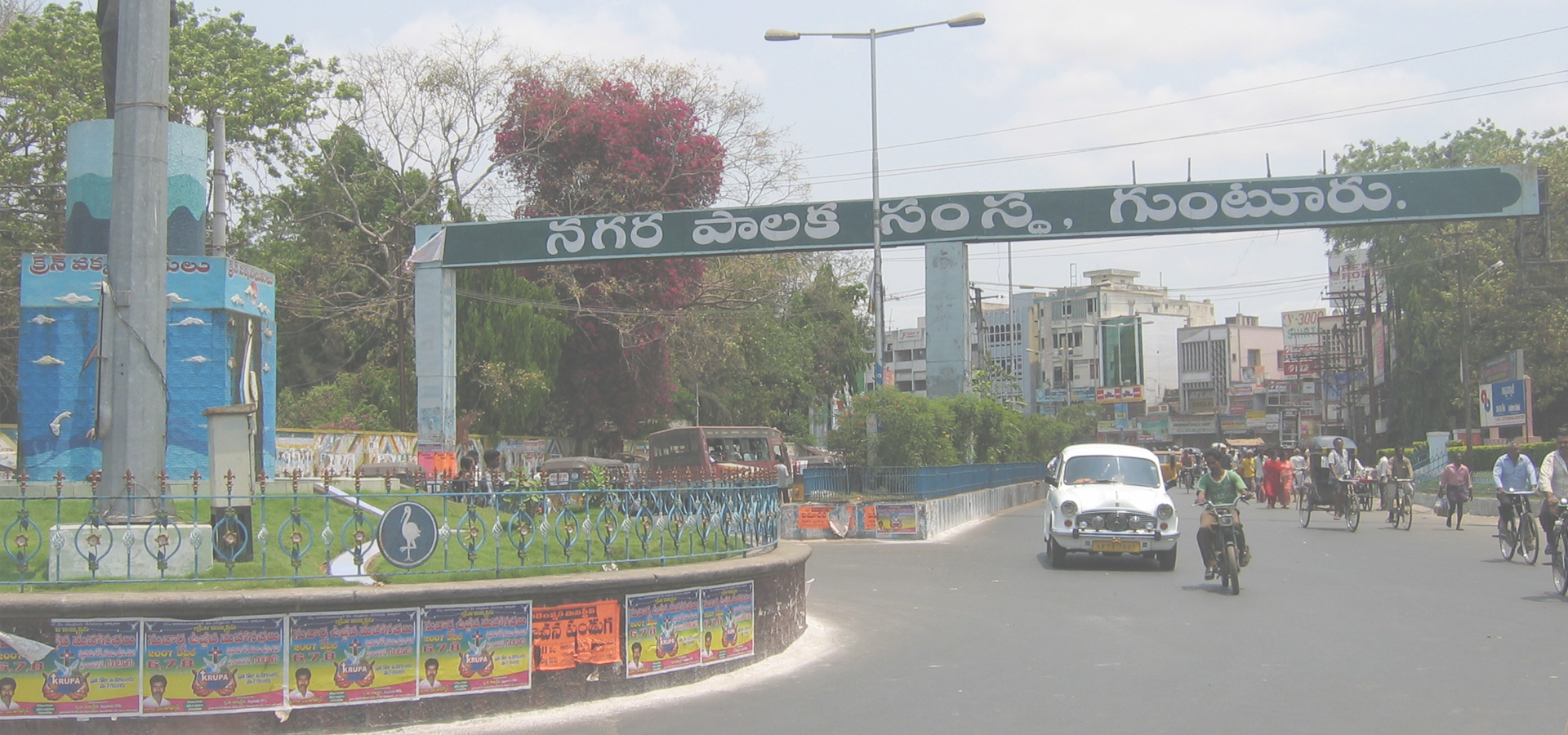

Guntur has a population of over 854,000 people. Guntur also forms the centre of the wider Guntur District which has a population of over 4,889,230 people. It is also a part of the larger Coastal Andhra Region.
To set up a UBI Lab for Guntur see: https://www.ubilabnetwork.org Twitter: https://twitter.com/UBILabNetwork
🇲🇽 Tehuantepec 16.317
🇭🇳 Coxen Hole 16.323
🇭🇳 Bay Islands 16.364
🇵🇭 Baguio City 16.412
🇬🇵 Les Abymes 16.27
🇫🇷 Pointe-à-Pitre 16.241
🇬🇵 Pointe-à-Pitre 16.241
🇬🇵 Point-à-Pitre 16.241
🇮🇳 Narasaraopet 16.236
🇹🇭 Taphan Hin 16.2
🇮🇳 Machilipatnam 16.17
🇮🇳 Amaravathi 80.517
🇮🇳 Mangalagiri 80.565
🇱🇰 Anuradhapura 80.4
🇱🇰 Sabaragamuwa 80.4
🇱🇰 Kurunegala 80.367
🇳🇵 Bheemdatta 80.333
🇮🇳 West Kanpur 80.332
Locations Near: Guntur 80.4428,16.3008
🇮🇳 Mangalagiri 80.565,16.438 d: 20
🇮🇳 Thenali 80.645,16.239 d: 22.7
🇮🇳 Amaravati 80.517,16.513 d: 24.9
🇮🇳 Amaravathi 80.517,16.513 d: 24.9
🇮🇳 Vijayawada 80.656,16.5 d: 31.7
🇮🇳 Narasaraopet 80.05,16.236 d: 42.6
🇮🇳 Bapatla 80.467,15.9 d: 44.6
🇮🇳 Chirala 80.357,15.828 d: 53.3
🇮🇳 Nandigama 80.3,16.783 d: 55.8
🇮🇳 Machilipatnam 81.13,16.17 d: 74.8
Antipodal to: Guntur -99.557,-16.301
🇵🇪 Paita -81.1,-5.083 d: 17647.1
🇵🇪 Sechura -80.817,-5.55 d: 17648.6
🇵🇪 Talara -81.267,-4.567 d: 17630.4
🇵🇪 Chiclayo -79.844,-6.764 d: 17622.7
🇵🇪 Piura -80.633,-5.2 d: 17610.7
🇵🇪 Sullana -80.683,-4.9 d: 17597.3
🇵🇪 Trujillo -79.034,-8.103 d: 17607.9
🇵🇪 Máncora -81.05,-4.1 d: 17581.1