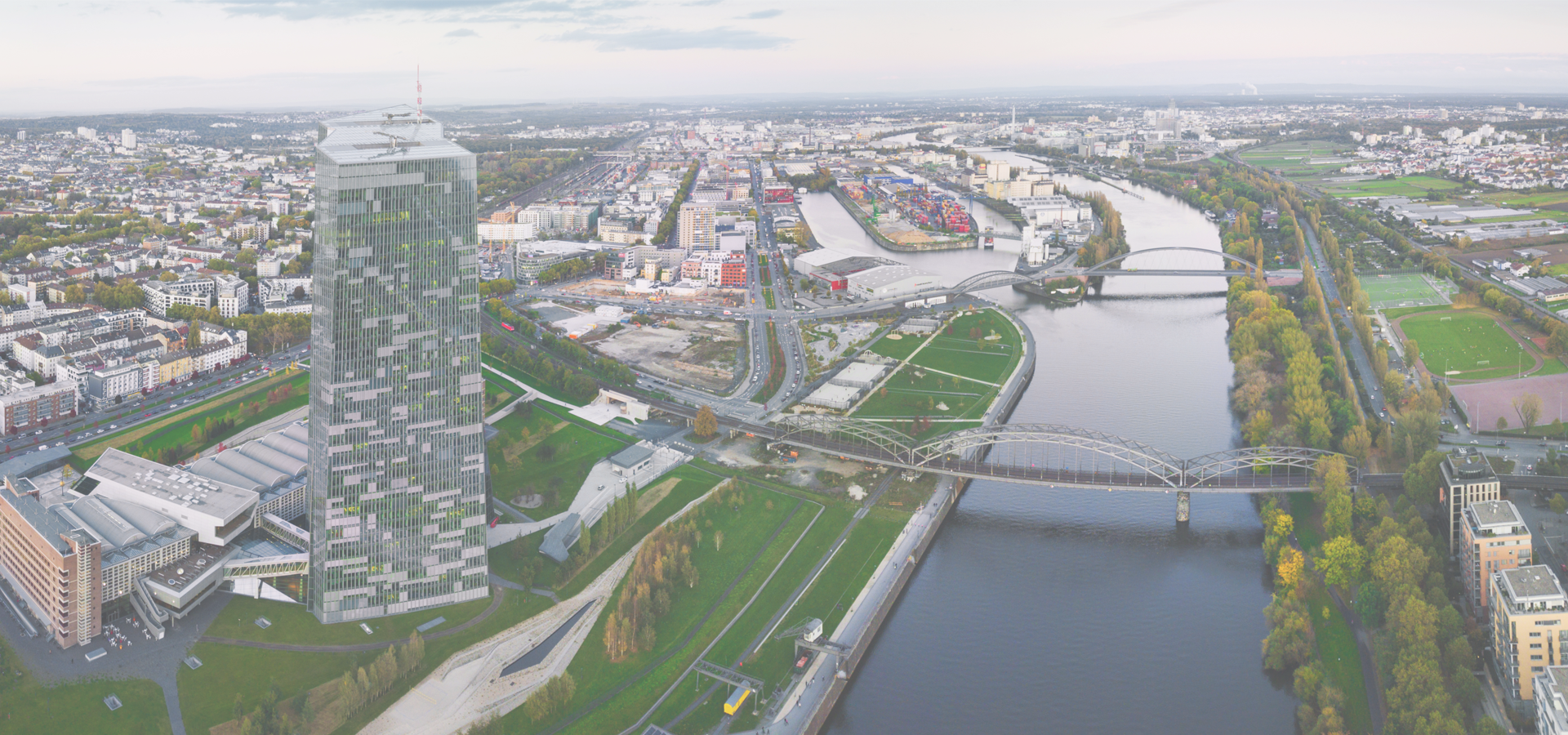
Frankfurt am Main, Hesse, Germany

European Central Bank | Deutsche Bundesbank | Commercial banks | Deutsche Bank | DZ Bank | KfW Bankengruppe | Commerzbank | Landesbank Hessen-Thüringen | DekaBank | ING Diba Germany | Frankfurt Stock Exchange | Frankfurt Trade Fair | Transport : Air | Accountancy and professional services | Credit rating agencies | Investment trust companies | Management consultancies | Real estate services companies | Law firms | Advertising agencies | Food | Automotive | Construction | Property and real estate | Tourist Industry | Other | Deutsche Bahn | Deutsche Telekom | COLT | CenturyLink | DE-CIX | Mainova | Suburban businesses | 20th-century architecture | Shopping streets | Green city | Culture : Museums : Music | Venues | Botanical gardens | Foreign culture | Festivals | Culture : Nightlife | Transport : Air : Road : Rail | Coach stations | Transport : Public : Tram : Bus | Taxis | Bicycles | E-Scooters | Courts of justice | European Insurance and Occupational Pensions Authority | Federal Financial Supervisory Authority | Anti-Money Laundering Authority | International Finance Corporation | Consulates | Education : University | Research institutes | Trade unions and associations | Media : Print | Magazines | Radio and TV | News agency

🇩🇪 Frankfurt, officially Frankfurt am Main, is a city in the German state of Hesse. Situated on the River Main, it forms a continuous conurbation with the neighbouring city of Offenbach am Main. The city is also the heart of the larger Rhine-Main Metropolitan Region. Frankfurt's central business district is known as Bankenviertel and designates an area in the city centre where many banks, insurance companies, and other financial institutions are located. It is the most important financial centre in Germany.

Frankfurt is a global hub for commerce, culture, education, tourism and transportation. It is the site of many global and European corporate headquarters. In addition, Frankfurt Airport is the busiest in Germany, one of the busiest in the world, the airport with the most direct routes in the world, and the primary hub for Lufthansa, the national airline of Germany. Frankfurt is one of the major financial centres of the European continent, with the headquarters of the European Central Bank, Deutsche Bundesbank, Frankfurt Stock Exchange, Deutsche Bank, DZ Bank, KfW, Commerzbank, several cloud and fintech startups and other institutes. Automotive, technology and research, services, consulting, media and creative industries complement the economic base. Frankfurt's DE-CIX is the world's largest internet exchange point. Messe Frankfurt is one of the world's largest trade fairs. Major fairs include the Music Fair and the Frankfurt Book Fair, the world's largest book fair.

Frankfurt is home to influential educational institutions, including the Goethe University, the UAS, the FUMPA and graduate schools like the Frankfurt School of Finance & Management. Its renowned cultural venues include the concert hall Alte Oper, continental Europe's largest English theatre and many museums (e.g. the Museumsufer ensemble with Städel and Liebieghaus, Senckenberg Natural Museum, Goethe House and the Schirn art venue at the old town). Frankfurt's skyline is shaped by some of Europe's tallest skyscrapers. The city is also characterised by various green areas and parks, including the central Wallanlagen, the City Forest, two major botanical gardens (the Palmengarten and the University's Botanical Garden) and the Frankfurt Zoo. In sports, the city is known as the home of the top-tier football club Eintracht Frankfurt, the Löwen Frankfurt ice hockey team, the basketball club Frankfurt Skyliners, the Frankfurt Marathon and the venue of Ironman Germany. It was also one of the host cities of the 1974 and 2006 FIFA World Cups.

Frankfurt is one of the world's most important financial centres and Germany's financial capital. The city's importance as a financial centre has risen since the establishment of two institutions: the European Insurance and Occupational Pensions Authority and the European Systemic Risk Board). According to an annual study by Cushman & Wakefield, the European Cities Monitor, Frankfurt has been one of the top three cities for international companies in Europe. Frankfurt has the highest concentration of jobs in Germany. On work days and Saturdays, one million people commute from all over the Rhein-Main-Area. Morgan Stanley, Citigroup Inc., Standard Chartered Plc and Nomura Holdings Inc. have all announced they would move their EU headquarters to Frankfurt. Frankfurt is home to two important central banks: the German Bundesbank and the European Central Bank (ECB).

European Central Bank The European Central Bank (Europäische Zentralbank) is one of the world's most important central banks. The ECB sets monetary policy for the Eurozone, consisting of 19 EU member states that have adopted the Euro (€) as their common currency. From 1998 the ECB Headquarters have been located in Frankfurt, first in the Eurotower at Willy-Brandt-Platz and in two other nearby high-rises. The new Seat of the European Central Bank in the Ostend district, consisting of the former wholesale market hall (Großmarkthalle) and a newly built 185-metre skyscraper, was completed in late 2014. The new building complex was designed to accommodate up to 2,300 ECB personnel. The location is a few km away from the city centre and borders an industrial area as well as the Osthafen (East Harbour), It was primarily chosen because of its large premises which allows the ECB to install security arrangements without high fences. The city honours the importance of the ECB by officially using the slogan "The City of the Euro" since 1998.

Deutsche Bundesbank The Deutsche Bundesbank (German Federal Bank), located in Ginnheim, was established in 1957 as the central bank for the Federal Republic of Germany. Until the euro (€) was introduced in 1999, the Deutsche Bundesbank was responsible for the monetary policy of Germany and for the German currency, the Deutsche Mark (DM). The Bundesbank was greatly respected for its control of inflation through the second half of the 20th century. Today the Bundesbank is an integral part of the European System of Central Banks (ESCB) which is formed by all 27 EU member states.

Commercial banks In 2010, 63 national and 152 international banks had a registered office, including the headquarters of the major German banks, as well as 41 offices of international banks. Frankfurt is therefore known as Bankenstadt ("City of the banks") and nicknamed "Mainhattan" (a portmanteau of the local Main river and Manhattan in New York City) or "Bankfurt". 73,200 people were employed at banks in 2010.

Deutsche Bank — Germany's largest commercial bank. It had 15% share of private customers and total assets of €1,900 billion in 2010. Deutsche Bank ranks among the 30 largest banks in the world and the ten largest banks in Europe. Deutsche Bank is listed on the DAX, the stock market index of the 30 largest German business companies at the Frankfurt Stock Exchange. In November 2010 Deutsche Bank bought the majority of shares of competitor Postbank. Its headquarters are located at Taunusanlage in the financial district.

DZ Bank — Central institution for more than 900 co-operative banks (Volksbanken und Raiffeisenbanken) and their 12,000 branch offices in Germany and is a corporate and investment bank. It is Germany's second-largest bank (total assets: €509 billion). The DZ Bank Group defines itself primarily as a service provider for the local Volksbanken and Raiffeisenbanken and their 30 million clients. The DZ Bank headquarters are the Westend Tower and the City-Haus at Platz der Republik. The DZ Bank Group includes Union Investment, DVB Bank and Reisebank, which are also headquartered in Frankfurt.

KfW Bankengruppe — Government-owned development bank formed in 1948 as part of the Marshall Plan. KfW provides loans for approved purposes at lower rates than commercial banks, especially to medium-sized businesses. With total assets of €507 billion (2017), it is Germany's third-largest bank. The KfW headquarters are located in the Westend district at Bockenheimer Landstraße and Senckenberganlage.

Commerzbank — Germany's fourth-largest bank by total assets (2017). In 2009, Commerzbank merged with competitor Dresdner Bank, then the third-largest German bank. Due to the merger and the higher credit risks, Commerzbank was 25% nationalized during the Great Recession. It is listed in the DAX. Its headquarters are at Commerzbank Tower (259 metres), the second-tallest building in the EU, at Kaiserplatz.

Landesbank Hessen-Thüringen – Landesbank Hessen-Thüringen, or short Helaba, is a commercial bank owned by the states of Hesse and Thuringia (Landesbank). As such, it is a service provider for the local German public banks (Sparkassen). Helaba is one of nine Landesbanken and is the fifth-largest in Germany. It is located in the 200-metre-tall Main Tower in the financial district, the only skyscraper in Frankfurt with an observation desk open to the public.

DekaBank – DekaBank is the central asset manager of the Sparkassen in Germany. The headquarters of DekaBank are located at the Trianon skyscraper at Mainzer Landstraße.

ING Diba Germany – Germany's largest direct bank, headquartered in Bockenheim.

Other major German banks include Frankfurter Volksbank, the second-largest Volksbank in Germany, Frankfurter Sparkasse and old-established private banks such as Bankhaus Metzler, Hauck & Aufhäuser and Delbrück Bethmann Maffei.

Many international banks have a registered or a representative office, e.g., Credit Suisse, UBS, Bank of America, Morgan Stanley, Goldman Sachs, Merrill Lynch, JPMorgan Chase & Co., Bank of China, Banco do Brasil, Itaú Unibanco Société Générale, BNP Paribas, SEB, Royal Bank of Scotland and Barclays.

Frankfurt Stock Exchange The Frankfurt Stock Exchange (Frankfurter Wertpapierbörse) began in the 9th century. By the 16th century Frankfurt had developed into an important European hub for trade fairs and financial services. Today the Frankfurt Stock Exchange is by far the largest in Germany, with a turnover of more than 90 percent of the German stock market and is the third-largest in Europe after the London Stock Exchange and the European branch of the NYSE Euronext. The most important stock market index is the DAX, the index of the 30 largest German business companies listed at the stock exchange. The stock exchange is owned and operated by Deutsche Börse, which is itself listed in the DAX. Deutsche Börse also owns the European futures exchange Eurex and clearing company Clearstream. Trading takes place exclusively via the Xetra trading system, with redundant floor brokers taking on the role of market-makers on the new platform.

On 1 February 2012 European Commission blocked the proposed merger of Deutsche Börse and NYSE Euronext. "The merger between Deutsche Börse and NYSE Euronext would have led to a near-monopoly in European financial derivatives worldwide. These markets are at the heart of the financial system and it is crucial for the whole European economy that they remain competitive. We tried to find a solution, but the remedies offered fell far short of resolving the concerns". European competition commissioner Joaquín Almunia said.

It is located in the city centre at the Börsenplatz. Deutsche Börse's headquarters are formally registered in Frankfurt, but it moved most of its employees to a high-rise called "The Cube" in Eschborn in 2010, primarily due to significantly lower local corporate taxes.

Frankfurt Trade Fair Frankfurt Trade Fair (Messe Frankfurt) has the third-largest exhibition site in the world with a total of 578,000 square metres (6,221,540 square feet). The trade fair premises are located in the western part between Bockenheim, the Westend and the Gallus district. It houses ten exhibition halls with a total of 321,754 square meters (3,463,331 square feet) of space and 96,078 square metres (1,034,175 square feet) of outdoor space.

Hosted in Frankfurt are the Frankfurt Motor Show (Internationale Automobil-Ausstellung – IAA), the world's largest auto show, the Frankfurt Book Fair (Frankfurter Buchmesse), the world's largest book fair, the Ambiente Frankfurt, the world's largest consumer goods fair, the Achema, the world's largest plant engineering fair, and many more like Paperworld, Christmasworld, Beautyworld, Tendence Lifestyle or Light+Building.

Messe Frankfurt GmbH, the owner and operator company, organized 87 exhibitions in 2010, 51 thereof in foreign countries. It is one of the largest trade fair companies with commercial activities in over 150 countries.

Transport: Air Frankfurt Airport is one of the busiest airports in the world and is also the single largest place of work in Germany with over 500 companies which employ 71,500 people. Fraport is the owner and operator of Frankfurt Airport. It is the airport's second-largest employer.

The largest company at Frankfurt Airport is Lufthansa, Germany's flag carrier and Europe's largest airline. Lufthansa employs 35,000 people in Frankfurt. The Lufthansa Aviation Center (LAC) is the main operation base of Lufthansa at Frankfurt Airport. The airport serves as Lufthansa's primary hub with 157 world-wide destinations. Lufthansa Cargo is based in Frankfurt and operates its largest cargo centre (LCC) at Frankfurt Airport. Lufthansa Flight Training is also based here.

Condor is a German airline based at Frankfurt Airport.

Accountancy and professional services Three of the four largest international accountancy and professional services firms (Big Four) are present. PricewaterhouseCoopers (PwC) German headquarters are located at Tower 185. KPMG moved its European Headquarters (KPMG Europe LLP) to The Squaire. Deloitte Touche Tohmatsu are present, while Ernst & Young is located in Eschborn.

Credit rating agencies The three major international credit rating agencies – Standard & Poor's, Moody's and Fitch Ratings – have their German headquarters in Frankfurt.

Investment trust companies DWS Investments is the largest investment trust company in Germany and manages €288 billion fund assets. It is one of the 10 largest investment trust companies in the world. Other large investment trust companies are Allianz Global Investors Europe (a division of Allianz SE, and a top-five global active investment manager with €1,933 billion assets under management globally), Union Investment and Deka Investmentfonds.

Management consultancies Many of the largest international management consultancies are represented, including Arthur D. Little, McKinsey & Company, Boston Consulting Group, Booz & Company, Oliver Wyman, Bearing Point, Capgemini, Bain & Company and Roland Berger Strategy Consultants.

Real estate services companies Located in Frankfurt are the German headquarters of Jones Lang LaSalle and BNP Paribas Real Estate.

Law firms Frankfurt has the highest concentration of lawyers in Germany, with one lawyer per 97 inhabitants. Most of the large international law firms maintain offices, among them Allen & Overy, Baker & McKenzie, Bird & Bird, Clifford Chance, Cleary Gottlieb Steen & Hamilton, Debevoise & Plimpton, DLA Piper, Freshfields Bruckhaus Deringer, Hogan Lovells, Jones Day, Latham & Watkins, Linklaters, Mayer Brown, Milbank, Tweed, Hadley & McCloy, Norton Rose, Shearman & Sterling, Sidley Austin, SJ Berwin, Skadden, Arps, Slate, Meagher & Flom, Sullivan & Cromwell, K&L Gates, Taylor Wessing and White & Case.

Advertising agencies Frankfurt is also a centre for media companies. Around 570 companies of the advertising industry and 270 public relations companies are there. According to a ranking of German FOCUS magazine seven of the 48 largest advertising agencies in Germany are based in Frankfurt, including Havas, Dentsu, McCann-Erickson, Saatchi & Saatchi, JWT, and Publicis.

Food Frankfurt is home to the German headquarters of Nestlé, the world's largest food company, located in Niederrad. Other important food companies are Ferrero SpA (German headquarters) and Radeberger Gruppe KG, the largest private brewery group in Germany.

Automotive The South-Korean automobile manufacturer Kia Motors moved its European headquarters to Frankfurt in 2007. In the same year, Italian manufacturer Fiat opened its new German headquarters. The automotive supplier Continental AG has the headquarters and a major manufacturing plant of its Chassis & Safety division (formerly ITT Automotive) located in Frankfurt Rödelheim.

Construction Some of the largest German construction companies have offices, e.g., Bilfinger Berger, Hochtief, Züblin and BAM Deutschland.

Property and real estate Frankfurt has Germany's highest concentration of homeowners. This is partly attributed to the financial sector, but also to its cosmopolitan nature, with expatriates and immigrants representing one-fourth of its population. For this reason, Frankfurt's property market often operates differently than the rest of the country where the prices are generally flatter.

Tourist Industry Frankfurt is one of Germany's leading tourist destinations. In addition to its infrastructure and economy, its diversity supports a vibrant cultural scene. This blend of attractions led 4.3 million tourists to visit Frankfurt. The Hotels in central Frankfurt offer 34,000 beds in 228 hotels, of which 13 are luxury hotels and 46 are first-class hotels.

Other Frankfurt is home to companies from the chemical, transportation, telecommunication and energy industries. Some of the larger companies are: Industriepark Höchst — An industrial park in Höchst. It is one of Germany's largest with over 90 companies from the pharmaceutical, the chemical and the biotechnology industry, including Celanese, Clariant, BASF, Merck KGaA and Siemens. It was founded by chemical company Hoechst AG in 1874. At the beginning of the 1980s Hoechst AG was the largest pharmaceutical corporation and Industriepark Höchst was known as "the pharmacy of the world". Hoechst AG merged with Rhône-Poulenc to become Aventis in 1999 and in 2004 Aventis merged with Sanofi-Synthélabo to become Sanofi-Aventis. In 2005, around 22,000 people worked at Industriepark Höchst. In 2011, Ticona now part of Celanese, an international manufacturer of engineering polymers, moved to Industriepark Höchst.

Deutsche Bahn – Deutsche Bahn subsidiaries DB Fernverkehr, DB Regio, DB Stadtverkehr, DB Netz, DB Schenker and the corporate development department of Deutsche Bahn are Frankfurt-based.

Deutsche Telekom – Deutsche Telekom's subsidiary T-Systems is Frankfurt-based.

COLT – Telecommunications company with Frankfurt-based German headquarters.

CenturyLink — internet service provider with German headquarters in Frankfurt.

DE-CIX – Frankfurt is an important location for electronic communication, especially the Internet. It is home to DE-CIX, the world's largest internet exchange point, and also the place where domain names are registered for top-level-domain ".de".

Mainova – The largest regional energy supplier in Germany with about one million customers in Hesse. It provides electricity, gas, heat and water. Its headquarters are Frankfurt-based.

Suburban businesses Within Frankfurt's urban area are several important companies.

The business centre of Eschborn is located right at Frankfurt's city limits in the west and attracts businesses with significantly lower corporate taxes compared to Frankfurt. Major companies in Eschborn include Ernst & Young, Vodafone Germany, Randstad Holding and VR Leasing. Deutsche Börse moved most of its employees to Eschborn in 2010.

Rüsselsheim is internationally known for its automobile manufacturer Opel, one of the biggest automobile manufacturers in Germany. With 20,000 employees in 2003, Opel was one of the five largest employers in Hesse.

Offenbach am Main is home to the European headquarters of automobile manufacturer Hyundai Motor Company, to the German headquarters of automobile manufacturer Honda, to Honeywell Germany and to Deutscher Wetterdienst, the central scientific agency that monitors weather and meteorological conditions over Germany.

Two DAX companies are located in Bad Homburg vor der Höhe, Fresenius SE & Co. KGaA and Fresenius Medical Care. Other major companies are Hewlett-Packard, Bridgestone, Deutsche Leasing and Basler Versicherungen.

Kronberg im Taunus is home of the German headquarters of automobile manufacturer Jaguar Cars as well as the German headquarters of Accenture.

Lufthansa Systems, a subsidiary of Lufthansa, is located in Kelsterbach.

LSG Sky Chefs, another subsidiary of Lufthansa, is located in Neu-Isenburg.

The German headquarters of Thomas Cook Group are based in Oberursel.

Langen is home to Deutsche Flugsicherung, the German air traffic control.

20th-century architecture • Frauenfriedenskirche and Holy Cross Church), both consecrated in 1929, are examples of early modernist church buildings during the time of the New Frankfurt. • Großmarkthalle, built 1926–1928 as a part of the New Frankfurt-project, the former wholesale market hall was repaired after the second world war and integrated into the new seat of the European Central Bank between 2010 and 2014. • Goethe House, rebuilt 1947. The birthplace of Johann Wolfgang von Goethe from 1749 was destroyed in World War II and then rebuilt true to the original. • Junior-Haus, built 1951, an example of early post-World War II architecture located at Kaiserplatz. • Bayer-Haus, built 1952, another example of early post-World War II architecture. • Museum für angewandte Kunst, built 1985, designed by Richard Meier. • IG Farben Building – Also known as Poelzig Building (Poelzig-Bau) after its architect Hans Poelzig, it was built from 1928 to 1930 as the corporate headquarters of I.G. Farbenindustrie AG. It is located in the Westend district and borders Grüneburgpark in the west. Upon its completion, the complex was the largest office building in Europe and remained so until the 1950s. The building served as headquarters for research projects relating to the development of synthetic oil and rubber and the manufacturing of magnesium, lubricating oil, explosives, methanol, and Zyklon B, the lethal gas used in concentration camps. After World War II, it served as the headquarters for the Supreme Allied Command and from 1949 to 1952 the High Commissioner for Germany (HICOG). It became the principal location for implementing the Marshall Plan, which largely financed the post-war reconstruction of Europe. The state apparatus of the Federal German Government was devised there. It served as the headquarters for the US Army's V Corps and the Northern Area Command (NACOM) until 1995 when the US Army returned control of the IG Farben Building to the German government. It was purchased on behalf of the Goethe University Frankfurt by the state of Hesse. In October 2001 it became part of the Westend Campus of Goethe University.

Shopping streets • Zeil – Frankfurt's central shopping street is a mile long and has been a shopping destination for more than a century. Only the western half of Zeil is pedestrianized. MyZeil is a stereotypical shopping mall. Three more shopping malls occupy the Zeil: UpperZeil (replacing the Zeilgalerie, which was demolished in 2016), Galeria Kaufhof and Karstadt, as well as large fashion retail clothing stores from Peek & Cloppenburg and C&A. During the month before Christmas, the extended pedestrian-only zone is host to Frankfurt Christmas Market, one of the largest and oldest Christmas markets in Germany. Zeil is bordered by two large public squares, Hauptwache in the west and Konstablerwache in the east. It is the second most expensive street for shops to rent in Germany after the Kaufingerstraße in Munich. 85 percent of the shops are retail chains such as H&M, Saturn, Esprit, Zara or NewYorker. • Goethestraße – Frankfurt's shopping destination for prestigious luxury shops like Louis Vuitton, Prada, Gucci, Tiffany, Giorgio Armani, Versace, Cartier, Burberry, Vertu and Bulgari. • Freßgass – (officially Kalbächer Gasse and Große Bockenheimer Straße) is a central pedestrian-only street section between Börsenstraße and Opernplatz. The name translates as "feeding alley" because of its high concentration of gastronomy, but lately prestigious shops (e.g., Apple Store, Hugo Boss, Porsche Design) have moved here due to the lack of space in the neighboring Goethestraße, displacing old, established restaurants, butchers and delicatessens. • Berger Straße – Frankfurt's longest shopping street. It starts in the city centre, runs through Nordend and Bornheim and ends in Seckbach. The street is less crowded than the Zeil and offers a greater variety of smaller shops, restaurants and cafés. • Leipziger Straße – Central shopping street in the Bockenheim district starting at Bockenheimer Warte going towards West. High density of shops for daily needs. • Braubachstraße – In the Altstadt district, close to the historic sites of the city, offers a large variety of art galleries, second-hand bookshops and antique shops. • Münchener Straße – In the Bahnhofsviertel district, located between the central station and Willy-Brandt-Platz, is the most multicultural shopping street with many shops selling imported products mainly from Turkey, the Middle East and Asia. • Kleinmarkthalle – (literally: Small Market Hall) is a market hall close to Konstablerwache square offering fresh food and flowers. In addition to regional delicacies like green sauce imported goods are offered. The Kleinmarkthalle is the largest public marketplace in Frankfurt.

Green city With a large forest, many parks, the Main riverbanks and the two botanical gardens, Frankfurt is considered a "green city": More than 50 percent of the area within the city limits are protected green areas. • Frankfurter Grüngürtel – The Green Belt is a ring-shaped public green space around the city. With 8,000 ha it covers a third of the administrative area. It includes the Frankfurter Stadtwald (Frankfurt City Forest, Germany's largest forest within a city), the Schwanheimer Düne (Schwanheim Dune), the Niddatal (Nidda Valley), the Niddapark, the Lohrberg (Lohr Mountain, Frankfurt's only vineyard), the Huthpark, the Enkheimer Ried (Enkheim Marsh), the Seckbacher Ried (Seckbach Marsh) and the Fechenheimer Mainbogen (a S-shaped part of the Main river in Fechenheim). The Green Belt is a protected area which means that housing is not allowed. The Green Belt was formally created in 1991 with its own constitution. • Mainuferpark – The Mainuferpark (Main Riverbanks Park) is the common term to describe the inner-city Main riverbanks. It is an auto-free zone with large green areas that is popular with strollers and tourists, especially in the summertime, when it can become crowded. The southern riverbank, which continues further to Offenbach am Main and Hanau, offers the best skyline views. The northern riverbank ends in the west at the former Westhafen (West Harbor, a residential housing area) and is growing to the east: A former industrial-used area between the new Seat of the European Central Bank and the Osthafen (East Harbor) has become a park named Hafenpark (Harbor Park), which offers outdoor courts for basketball, soccer and a skatepark. • Wallanlagen – The Wallanlagen (former ramparts) relate to the former ring-shaped city wall fortifications around the Altstadt and the Innenstadt district (abolished 1804–1812), now a series of parks. Building is not allowed, with a few exceptions, the most famous being the Alte Oper (built 1880) at the Opernplatz. The part between the northern Main riverbank and the Opernplatz, referred to officially as Taunusanlage and Gallusanlage, is locally known as "Central Park" (a reference to the famous park in Manhattan), because of the skyscrapers which stand on both sides. • Nizza Park – At the juncture of the northern Main riverbank and the Wallanlagen is a famous small park called Nizza. The name of the park recalls Nice in southern France, because it is one of the warmest areas with a nearly mediterranean climate. Numerous Mediterranean flora grow there and can survive outside during the winter. • Garten des Himmlischen Friedens – "Garden of Heavenly Peace", named after the Tiananmen Gate in Beijing, is a Chinese-styled park in the Nordend district and part of the larger Bethmannpark. It contains Chinese buildings, with building materials imported from China and built by Chinese workers in the 1980s. Hosts traditional Chinese plants and herbs. • Other parks – The largest parks are the Niddapark (168 ha), the Ostpark (32 ha) and the Grüneburgpark (29 ha).

Culture: Museums With more than 30 museums, Frankfurt has one of the largest variety of museums in Europe. Most museums are part of the Museumsufer, located on the front row of both sides of the Main riverbank or nearby, which was created on an initiative by cultural politician Hilmar Hoffmann.

Ten museums are located on the southern riverbank in Sachsenhausen between the Eiserner Steg and the Friedensbrücke. The street itself, Schaumainkai, is partially closed to traffic on Saturdays for Frankfurt's largest flea market. • Deutsches Architekturmuseum (German Architecture Museum) • German Film Museum  (Deutsches Filmmuseum) • Deutsches Romantik-Museum • Frankfurter Ikonenmuseum (Icon Museum Frankfurt) • Liebieghaus (Museum of sculptures) • Museum Angewandte Kunst (Museum of Applied Arts) • Museum Giersch (Museum for Regional Art) • Museum für Kommunikation (Museum of Communications) • Museum der Weltkulturen (Museum of World Cultures) • Städel, one of the most famous art museums in Germany • Museum für elektronische Musik (Museum of Modern Electronic Music) • Bibelhaus Erlebnis Museum (Bible House Experience Museum)

Two museums are located on the northern riverbank: • Jüdisches Museum Frankfurt (Jewish Museum Frankfurt) • Historisches Museum Frankfurt (Historical Museum Frankfurt)

Not directly located on the northern riverbank in the Altstadt district are: • Museum für Moderne Kunst (Museum of Modern Art) • Schirn Kunsthalle Frankfurt (Schirn Art Gallery Frankfurt) • Frankfurter Kunstverein (Art Association Frankfurt) • Museum Judengasse (Jews' Alley Museum) • Goethe-Haus (Goethe House) • Archäologisches Museum Frankfurt (Archaeological Museum Frankfurt) • Caricatura Museum für Komische Kunst (Caricatura Museum of Comic Art) • Dommuseum Frankfurt (Frankfurt Cathedral Museum)

Another important museum is located in the Westend district: • Naturmuseum Senckenberg (Senckenberg Natural History Museum), the second-largest natural history museum in Germany

Other museums are the Dialogmuseum (Dialogue Museum) in the Ostend district, Eintracht Frankfurt Museum at Deutsche Bank Park, the Frankfurter Feldbahnmuseum (Light Railway Museum Frankfurt) in the Gallus district, the Verkehrsmuseum Frankfurt (Transport Museum Frankfurt) in the Schwanheim district, the Hammer Museum in the Bahnhofsviertel district and the Geldmuseum der Deutschen Bundesbank (Money Museum of the German Federal Bank) in the Ginnheim district. The Explora Museum+Wissenschaft+Technik (Explora Museum of Science and Engineering) in the Nordend district was closed in 2016. Most museums open around 10:00 am local time, and it is possible to comfortably visit four museums in one day, a fact many tourists take advantage of.

Culture: Music Eurodance and Trance music originated in Frankfurt. In 1989 German producers Michael Münzing and Luca Anzilotti (under the pseudonyms Benito Benites and John "Virgo" Garrett III) formed the Snap! project. Snap! songs combined Rap and Soul vocals adding rhythm by using computer technology and mixing electronic sounds, bass and drums. By doing so a new genre was born: Eurodance. In the early 1990s, DJs including Sven Väth and DJ DAG (of Dance 2 Trance) first played a harder, deeper style of acid house that became popular worldwide over the next decade as Trance music. Some of the early and most influential Eurodance, Trance and Techno acts, e.g., La Bouche, Jam and Spoon, Magic Affair, Culture Beat, Snap!, Dance 2 Trance, Oliver Lieb and Hardfloor, and record labels such as Harthouse and Eye Q, were based in the city in the early 1990s.

Venues • Oper Frankfurt – A leading Germany opera company and one of Europe's most important. It was elected Opera house of the year (of Germany, Austria and German-speaking Switzerland) by German magazine Opernwelt several times. It was also elected Best opera house in Germany in 2010 and 2011. Its orchestra was voted Orchestra of the year in 2009, 2010 and 2011. It is part of the Double System Städtische Bühnen Frankfurt. • Schauspiel Frankfurt – Theater at Willy-Brandt-Platz in the financial district, next to the Frankfurt Opera in the Double System Städtische Bühnen Frankfurt. • Festhalle Frankfurt – Multi-purpose hall next to the Messeturm at the grounds of the Frankfurt Trade Fair. It is mostly used for concerts, exhibitions or sport events and can accommodate up to 13,500. • Deutsche Bank Park – Frankfurt's largest sports stadium and the seventh largest in Germany. It is located in the Frankfurt City Forest near Niederrad. It is primarily used for soccer and concerts with a capacity up to 58,000. It opened in 1925 and underwent several major reconstructions. Locals still prefer to call the stadium by its traditional name, Waldstadion (Forest Stadium). Home to Eintracht Frankfurt. • Alte Oper – A major concert hall. Venue of the Frankfurt Radio Symphony (hr-Sinfonieorchester), the radio orchestra of the Hessischer Rundfunk and the Frankfurter Opern- und Museumsorchester. • hr-Sendesaal – Venue of the Frankfurt Radio Symphony. • Jahrhunderthalle – Century Hall is a large concert and exhibition hall in Unterliederbach district. Sometimes referred to as "Jahrhunderthalle Höchst", because it was built to celebrate the 100th anniversary of the chemical company Hoechst AG in 1963. • The English Theatre – Located on the ground floor of the Gallileo high-rise building, this is the largest English theater in continental Europe. It was established in 1979. • Tigerpalast – Tiger Palace is a varieté near the Zeil. It was established in 1988 and houses the famous Tiger-Restaurant which was awarded a Michelin star. • Künstlerhaus Mousonturm – House of Artists Mouson Tower has a smaller budget than traditional theaters and uses more unconventional performing methods. It is located in an old factory in the Ostend district. • Die Schmiere – The Grease is a cabaret operational since 1950 focusing on satire. • Die Komödie – The Comedy is a boulevard theater near downtown Frankfurt's Willy-Brandt-Platz.

Botanical gardens Frankfurt is home to two major botanical gardens: • Palmengarten is located in the Westend district and is Hesse's largest botanical garden, covering 22 ha (54 acres). It opened to the public in 1871. Designed by the architect Heinrich Siesmayer the botanical exhibits in free-air or in greenhouses include agave, succulents and azaleas. • Botanischer Garten der Goethe-Universität is arboretum. It contains about 5,000 species, with special collections of Rubus (45 species) and indigenous plants of central Europe. It is organized into two major areas: The geobotanical area contains an alpine garden, arboretum, meadows, steppes, marsh, and a pond, as well as collections of plants from the Canary Islands, Caucasus, East Asia, Mediterranean, and North America and the systematic and ecological collection includes crop plants, endangered species, ornamental plants, roses, and the Neuer Senckenbergischer Arzneipflanzengarten (New Senckenberg Medicinal Plant Garden), which measures 1,200 m2 (13,000 sq ft). The Botanical Garden, Palmengarten, Grüneburgpark collectively form the largest inner-city green area.

Foreign culture • Instituto Cervantes – Named after Miguel de Cervantes, one of the most important Spanish authors, this is the world's largest organization for promoting the study and teaching of Spanish language and culture. 54 such Centros Cervantes across the world offer Spanish language and history courses. The Frankfurt branch was officially opened in September 2008 by Felipe, Prince of Asturias and his wife Letizia, Princess of Asturias. It is located in the so-called Amerika-Haus. • Institut Français – A French public industrial and commercial organization (EPIC), started in 1907 by the Ministry of Foreign Affairs for promoting French, francophone as well as local cultures around the world. The French Institute works closely with the French cultural network abroad consisting of more than 150 branches and nearly 1,000 branches of the Alliance française around the world. • Istituto Italiano di Cultura – A worldwide non-profit organization created by the Italian government. It promotes Italian culture and is involved in the teaching of the Italian language; there are 83 Italian Cultural Institutes throughout major cities around the world. • Confucius Institute – A non-profit public educational organization affiliated with the Ministry of Education of the People's Republic of China, whose aim is to promote Chinese language and culture, support local Chinese teaching internationally, and facilitate cultural exchanges. There are over 480 Confucius Institutes worldwide. • Central and Eastern European Online Library – CEEOL is an online archive providing access to full-text articles from humanities and social science scholarly journals on Central, Eastern and South-Eastern European topics. Subject areas include anthropology, culture and society, economy, gender studies, history, Judaic studies, fine arts, literature, linguistics, political sciences and social sciences, philosophy and religion. CEEOL is operated by Questa.Soft GmbH.

Festivals • Museumsuferfest – Museums Riverbank Festival is one of Germany's biggest cultural festivals, attracting more than 3 million visitors over three days at the end of August along the Main riverbank downtown. The 20 museums there open far into the night. It offers live music, dance shows, booths for crafts, jewelry, clothes and food stands from around the world. • Dippemess – Frankfurt's oldest folk festival is the Festival of Stoneware, which takes place semi-annually around Easter and the end of September in the eastern area. "Dippe" is a regional Hessian dialect word meaning "pot" or "jar" which would not be understood in most other German regions. Mentioned for the first time in the 14th century as an annual marketplace it is now more of an amusement park. The name of the festival derives from its original purpose when it was a fair where traditionally crafted jars, pots and other stoneware were on offer. • Luminale — The "festival of light" has taken place biannually since 2000, parallel to the Light + building exhibition at the trade fair. Many buildings are specially lit for the event. In 2008, more than 220 light installations could be seen, attracting 100,000 visitors. • Wäldchestag – Day of the forest is known as a regional holiday because until the 1990s it was common that Frankfurt's shops were closed on this day. The festival takes place over four days after Pentecost with the formal Wäldchestag on Tuesday. Its unique location is in the Frankfurt City Forest, south-west of downtown in Niederrad. "Wäldches" is a regional dialect of the German word "Wäldchen", meaning "small forest". • Nacht der Museen – Night of the museums takes place every year in April or May. 50 museums in Frankfurt and in the neighboring city of Offenbach am Main are open until 2:00 am surrounded by special music events, dance performances, readings and guided tours. A free shuttle operates between the museums. In 2010, approximately 40,000 visitors attended. • Nacht der Clubs – Night of the clubs is an event similar to Nacht der Museen: On one night as many as 20 clubs can be visited with a single ticket for €12. Usually, club-door policies are loosened to attract new customers. A free shuttle runs between the clubs. 15,000 people participated in 2008. • Wolkenkratzer Festival — The Skyscraper Festival is unique in Germany. It takes place irregularly, lately in May 2013, and attracted around 1.2 million visitors. For two days most skyscrapers are open to the public. Sky-divers, base jumpers, fireworks and laser shows are extra attractions.

Culture: Nightlife Frankfurt offers a variety of restaurants, bars, pubs and clubs. Clubs concentrate in and around downtownand in the Ostend district, mainly close to Hanauer Landstraße. Restaurants, bars and pubs concentrate in Sachsenhausen, Nordend, Bornheim and Bockenheim.

In electronic music, Frankfurt was a pioneering city in the late 1980s and early 1990s, with renowned DJs including Sven Väth, Marc Trauner, Scot Project and Kai Tracid. One of the main venues of the early Trance music sound was the Omen nightclub  from 1988 to 1998. Another popular disco club of the 1980s–1990s and a hotspot for Techno/Trance music was the Dorian Gray, which was located within Terminal 1 at Frankfurt Airport from 1978 to 2000. Further popular venues were the U60311  (1998–2012) and the Coocoon Club in Fechenheim (2004–2012). Notable live music venues of the past include the Sinkkasten Arts Club  (1971–2011) and the King Kamehameha Club  (1999–2013).

Among the most popular active rock and pop concert venues is the Batschkapp in Seckbach, which opened in 1976 as a centre for autonomous and left-wing counterculture.

Transport: Air Frankfurt Airport

The city can be accessed from around the world via Frankfurt Airport (Flughafen Frankfurt am Main) located 12 km (7 mi) south-west of downtown. The airport has four runways and serves 265 nonstop destinations. Run by transport company Fraport it ranks among the world's busiest airports by passenger traffic and is the busiest airport by cargo traffic in Europe. The airport also serves as a hub for Condor and as the main hub for German flag carrier Lufthansa. It is the busiest airport in Europe in terms of cargo traffic, and the fourth busiest in Europe in terms of passenger traffic behind London Heathrow Airport, Paris Charles de Gaulle Airport and Amsterdam Airport Schiphol. Passenger traffic at Frankfurt Airport in 2018 was 69,510,269 passengers.

A third terminal is being constructed (planned to open in 2026). The third terminal will increase the capacity of the airport to over 90 million passengers per year.

The airport can be reached by car or bus and has two railway stations, one for regional and one for long-distance traffic. The S-Bahn lines S8 and S9 (direction Offenbach Ost or Hanau Hbf) departing at the regional station take 10–15 minutes from the airport to Frankfurt Central Station and onwards to Hauptwache station downtown), the IC and ICE trains departing at the long-distance station take 10 minutes to Frankfurt Central Station.

Frankfurt Hahn Airport

Despite the name, Frankfurt Hahn Airport (Flughafen Frankfurt-Hahn) is situated approximately 120 km (75 mi) from the city in Lautzenhausen (Rhineland-Palatinate). Hahn Airport is a major base for low-cost carrier Ryanair. This airport can only be reached by car or bus. An hourly bus service runs from Frankfurt Central Station, taking just over 2 hours. Passenger traffic at Hahn Airport in 2010 was 3.5 million.

Frankfurt Egelsbach Airport

Frankfurt Egelsbach Airport (Flugplatz Frankfurt-Egelsbach) is a busy general aviation airport located south-east of Frankfurt Airport, near Egelsbach.

Transport: Road Frankfurt is a traffic hub for the German motorway (Autobahn) system. The Frankfurter Kreuz is an Autobahn interchange close to the airport, where the Bundesautobahn 3 (A3), Cologne to Würzburg, and the Bundesautobahn 5 (A5), Basel to Hanover, meet. With approximately 320,000 cars passing through it every day, it is Europe's most heavily used interchange. The Bundesautobahn 66 (A66) connects Frankfurt with Wiesbaden in the west and Fulda in the east. The Bundesautobahn 661 (A661) is mainly a commuter motorway that starts in the south (Egelsbach), runs through the eastern part and ends in the north (Oberursel). The Bundesautobahn 648 (A648) is a very short motorway in the western part which primarily serves as a fast connection between the A 66 and the Frankfurt Trade Fair. The A5 in the west, the A3 in the south and the A661 in the north-east form a ring road around the inner city districts and define a Low-emission zone (Umweltzone; established in 2008), meaning that vehicles have to meet certain emission criteria to enter the zone.

The streets of central Frankfurt are usually congested with cars during rush hour. Some areas, especially around the shopping streets Zeil, Goethestraße and Freßgass, are pedestrian-only streets.

Transport: Rail Frankfurt Central Station

(Frankfurt Hauptbahnhof, often abbreviated as Frankfurt (Main) Hbf or F-Hbf) is the largest railway station in Germany by railway traffic. By daily passenger volume, it ranks second (493,000 each) after Hamburg Central Station (550,000). It is located between the Gallus, the Gutleutviertel and the Bahnhofsviertel district, not far away from the trade fair and the financial district. It serves as a major hub for long-distance trains (InterCity, ICE) and regional trains as well as for Frankfurt's public transport system. It is a stop for most of ICE high-speed lines, making it Germany's most important ICE station. ICE Trains to London via the Channel Tunnel were planned for 2013. All Rhine-Main S-Bahn lines, two U-Bahn lines (U4, U5), several tram and bus lines stop there. Regional and local trains are integrated in the Public transport system Rhein-Main-Verkehrsverbund (RMV), the second-largest integrated public transport systems in the world, after Verkehrsverbund Berlin-Brandenburg.

Frankfurt Airport stations

Frankfurt Airport can be accessed by two railway stations: Frankfurt Airport long-distance station (Frankfurt Flughafen Fernbahnhof) is only for long-distance traffic and connects the airport to the main rail network, with most of the ICE services using the Cologne-Frankfurt high-speed rail line. The long-distance station is located outside the actual airport ground but has a connecting bridge for pedestrians to Terminal 1, concourse B. Frankfurt Airport regional station (Frankfurt Flughafen Regionalbahnhof) is for local S-Bahn trains (lines S8, S9) and regional trains. The regional station is located within Terminal 1, concourse B.

Frankfurt South station

Frankfurt's third long-distance station is Frankfurt South station (Frankfurt Südbahnhof, often abbreviated as Frankfurt (Main) Süd or F-Süd), located in Sachsenhausen. It is an important destination for local trains and trams (lines 15, 16 and 18) and the terminal stop for four U-Bahn lines (U1, U2, U3, U8) as well as three S-Bahn lines (S3, S4, S5). Line S6 also serves the station.

Messe stations

The Frankfurt Trade Fair offers two railway stations: Messe station is for local S-Bahn trains (lines S3-S6) and is centrally located amid trade fair premises, while Festhalle/Messe station is served by U-Bahn line U4 and is located at the north-east corner of the premises.

Konstablerwache station and Hauptwache station

Two other major downtown railway stations are Konstablerwache and Hauptwache, located on each end of the Zeil. They are the main stations to change from east-to-west-bound S-Bahn trains to north-to-south-bound U-Bahn trains. Konstablerwache station is the second-busiest railway station regarding daily passenger volume (98,000) after the central station. The third-busiest railway station is Hauptwache station (93,000).

Frankfurt West Station

This Station, located in Bockenheim, is served by north-heading Long-Distance ICE trains, multiple regional trains, and four commuter S-Bahn lines (S3, S4, S5, S6). Additionally, it is an important terminal stop for three "Metrobus" lines (M32, M36, M73).

Coach stations There are three stations for intercity bus services in Frankfurt: one at the south side of the Central Station, one at the Terminal 2 of the airport and another one at Stephanstraße.

Transport: Public The city has two rapid transit systems: the U-Bahn and the S-Bahn, as well as an above-ground tram system. Information about the U- and S-Bahn can be found on the website of the RMV.

S-Bahn

Nine S-Bahn lines (S1 to S9) connect Frankfurt with the densely populated Rhine Main Region. Most routes have at least 15-minute service during the day, either by one line running every 15 minutes, or by two lines servicing one route at a 30-minute interval. All lines, except line S7, run through the Frankfurt City Tunnel and serve stations at Ostendstraße, Konstablerwache, Hauptwache, Taunusanlage and Frankfurt Central Station. When leaving the city the S-Bahn travels above ground. It provides access to the trade fair (S3, S4, S5, S6), the airport (S8, S9), the stadium (S7, S8, S9) and nearby cities such as Wiesbaden, Mainz, Darmstadt, Rüsselsheim, Hanau, Offenbach am Main, Oberursel, Bad Homburg, Kronberg, Friedberg and smaller towns that are on the way. The S8/S9 runs 24/7.

U-Bahn

The U-Bahn has nine lines (U1 to U9) serving Frankfurt and the larger suburbs of Bad Homburg and Oberursel in the north. The trains that run on the U-Bahn are in fact light rail (Stadtbahn) as many lines travel along a track in the middle of the street instead of underground. The minimum service interval is 2.5 minutes, although the usual pattern is that each line runs at 7.5- to 10-minute intervals, which produce between 3- and 5-minute intervals on downtown tracks shared by more than one line.

Transport: Tram Frankfurt has ten tram lines (11, 12, 14 to 21), with trams arriving usually every 10 minutes. Many sections are served by two lines, combining to run at 5-minute intervals during rush-hour. Trams only run above ground and serve more stops than the U-Bahn or the S-Bahn.

Transport: Bus A number of bus lines complete the Frankfurt public transport system. Night buses replace U-Bahn and tram services between 1:30 am and 3:30 am. The central junction for the night bus service is at the downtown square of Konstablerwache, where all night bus lines start and end.

Taxis Taxicabs can usually be found outside the major S-Bahn and U-Bahn stations, at the central station, the south station, the airport, the trade fair and in the crowded inner-city shopping streets. The common way to obtain a taxi is to either call a taxi operator or to go to a taxi rank. However, although not the norm, one can hail a passing taxi on the street.

Uber ceased operations in Frankfurt on 9 November 2015 after operating in the city for 18 months. However, UberX and local cabs are available through the Uber app.

Bicycles Deutsche Bahn makes bicycles available for hire through their Call a Bike service. The bicycles are stationed all over the city, including at selected railway stations. They can easily be spotted because of their eye-catching silver-red color. To rent a specific bike, riders either call a service number to get an unlock code or reserve the bike via the smartphone application. To return the bike, the rider locks it within a designated return area (and calls the service number, if not booked via the app).

Nextbike also makes bicycles available for hire in Frankfurt. They are stationed all over the city. These can be spotted with their blue color scheme.

Cycle rickshaws (velotaxis), a type of tricycle designed to carry passengers in addition to the driver, are also available. These are allowed to operate in pedestrian-only areas and are therefore practical for sightseeing.

Frankfurt has a network of cycle routes. Many long-distance bike routes into the city have cycle tracks that are separate from motor vehicle traffic. A number of downtown roads are "bicycle streets" where the cyclist has the right of way and where motorized vehicles are only allowed access if they do not disrupt the cycle users. In addition, cyclists are allowed to ride many cramped one-way streets in both directions. As of 2015, 15 percent of citizens used bicycles.

E-Scooters Since 15 June 2019, the use of e-scooters was officially permitted by the German federal government. In Frankfurt, companies like Lime, TIER, Bird, voi., Dott or Bolt are offering their electric micro mobility vehicles for lease. However, their use is being regarded with increasing weariness due to frequent abuse (parking, speeding, vandalism, accidents) and has sparked a public debate about the need of further regulation of the e-scooter market.

Courts of justice Several courts are located in Frankfurt, including: • Hessisches Landesarbeitsgericht (Hessian State Employment Court) • Oberlandesgericht Frankfurt (Higher Regional Court Frankfurt) • Landgericht Frankfurt (Regional Court Frankfurt) • Amtsgericht Frankfurt (Local Court Frankfurt) • Sozialgericht Frankfurt (Social Court Frankfurt) • Arbeitsgericht Frankfurt (Employment Court Frankfurt) • Verwaltungsgericht Frankfurt (Administration Court Frankfurt)

European Insurance and Occupational Pensions Authority The European Insurance and Occupational Pensions Authority (EIOPA) is an institution of the EU and part of the European System of Financial Supervisors that was created in response to the 2008 financial crisis. It was established on 1 January 2011.

Federal Financial Supervisory Authority Frankfurt is one of two locations of the German Federal Financial Supervisory Authority (Bundesanstalt für Finanzdienstleistungsaufsicht, short: BaFin). The BaFin is an independent federal institution and acts as Germany's financial regulatory authority.

Anti-Money Laundering Authority The Anti-Money Laundering Authority (AMLA) of the European Union (EU) is based in Frankfurt.

International Finance Corporation Frankfurt is home to the German office of the International Finance Corporation (IFC), which is part of the World Bank Group. The IFC promotes sustainable private sector investment in developing countries.

Consulates As a profoundly international city, Frankfurt hosts 93 diplomatic missions (consulates and consulates-general). The Consulate General of the United States in Eckenheim is the largest American consulate in the world.

Education: University Frankfurt hosts two universities and several specialist schools. The two business schools are Goethe University Frankfurt's Goethe Business School and Frankfurt School of Finance & Management.

Johann Wolfgang Goethe University

The oldest and best-known university is the Johann Wolfgang Goethe University, with locations in Bockenheim, Westend, and Riedberg, and the university hospital in Niederrad. Goethe Business School is part of the university's House of Finance at Campus Westend. The Business School's Full-Time MBA program has over 70% international students.

Frankfurt University of Applied Sciences

The Frankfurt University of Applied Sciences was created out of several older organisations in 1971, and offers over 38 study areas, in the arts, sciences, engineering and law. Some of the most important research projects: Planet Earth Simulator, FraLine-IT-School-Service, quantitative analysis of methane in human corpses with the help of a mass spectrometer, software engineering (e.g., fraDesk), analysis of qualitative and quantitative gas in human lungs, long-term studies on photovoltaic modules (to name only a few).

Frankfurt School of Finance and Management

The city is also home to a business school, Frankfurt School of Finance & Management, formerly known as the Hochschule für Bankwirtschaft (Institution of Higher Learning for Banking Economics), with its new campus near Deutsche Nationalbibliothek U-Bahn stop (recently moving from its previous location in the Ostend (Eastend) neighborhood). In 2001, it became a specialist institution for Economics and Management, or FOM. Frankfurt School is consistently ranked among the best business schools in the world, attributed to its high research output and quality of undergraduate and graduate training.

Städelschule

Frankfurt has the State Institution of Higher Learning for Artistic Education known as the Städelschule, founded in 1817 by Johann Friedrich Städel. It was taken over by the city in 1942 and turned into a state art school.

Music schools and conservatory

Music institutions are the Frankfurt University of Music and Performing Arts, and the Hoch Conservatory (Dr. Hoch's Konservatorium) which was founded in 1878. The International Ensemble Modern Academy is a significant institution for the study of contemporary music.

Other notable schools

The Sankt Georgen Graduate School of Philosophy and Theology (German:Philosophisch-Theologische Hochschule Sankt Georgen), a private institution with membership in the German Jesuit Association, has been located in Sachsenhausen since 1950.

Education and media

Frankfurt schools rank among the best-equipped schools nationwide for the availability of PCs and other media facilities. In order to assure maintenance and support of the school PCs, the city in cooperation with the University of Applied Sciences launched the project Fraline – IT-Schul-Service, an initiative employing students to provide basic school IT-support.

Research institutes The city is home to three Max Planck Society institutes: the Max Planck Institute for Legal History and Legal Theory, Max Planck Institute for Biophysics, and the Max Planck Institute for Brain Research.

The Frankfurt Institute for Advanced Studies, sponsored by several institutional and private sources, is involved in theoretical research in physics, chemistry, neuroscience, and computer science.

Frankfurt is host to the Römisch-Germanische-Kommission (RGK), the German Archaeological Institute branch for prehistoric archeology in Germany and Europe. The RGK is involved in a variety of research projects. Its library, with over 200,000 items, is one of the largest archeological libraries in the world.

Goethe University and Frankfurt University of Applied Sciences are involved in the Hessian Center for Artificial Intelligence ("hessian.AI").

Trade unions and associations Frankfurt is home to multiple trade unions and associations, including: • IG Metall, Germany's largest metalworkers trade union, based at the Main Forum high-rise building in the Gutleutviertel district • IG Bauen-Agrar-Umwelt, a union for construction and engineering workers, • Gewerkschaft Erziehung und Wissenschaft, a union for teachers • Gewerkschaft Deutscher Lokomotivführer, a union for train drivers

Trade associations include: • Verband der Elektrotechnik, Elektronik und Informationstechnik (Electrotechnical, Electronic and Information Technology Association) • DECHEMA Gesellschaft für Chemische Technik und Biotechnologie (Applied Chemistry and Biotechnology Association) • Börsenverein des Deutschen Buchhandels, which organizes the Frankfurt Book Fair • Bundesverband des Deutschen Versandhandels (German Mail Order Industry Association) • Verband der Chemischen Industrie (Chemical Industry Association) • Verband der Photoindustrie (Photography Industry Association) • Verband Deutscher Maschinen- und Anlagenbau (German Machine and Equipment Building Association) • Verband der Köche Deutschlands (German Cooks Association)

Media: Print Two important daily newspapers are published. The conservative Frankfurter Allgemeine Zeitung, also known as FAZ, was founded in 1949 and is the German newspaper with the widest circulation outside of Germany, with its editors claiming to deliver the newspaper to 148 countries every day. The FAZ has a circulation of over 380,000 copies daily. The other important newspaper, the Frankfurter Rundschau, was first published in 1945 and has a daily circulation of over 181,000.

Magazines Several magazines also originate from Frankfurt. The local Journal Frankfurt is the best-known magazine for events, parties, and "insider tips". Öko-Test is a consumer-oriented magazine that focuses on ecological topics. Titanic is a well-known and often criticized satirical magazine with a circulation of approximately 100,000.

Radio and TV Frankfurt's first radio station was the Südwestdeutsche Rundfunkdienst AG (Southwest German Broadcast Service), founded in 1924. Its successor service is the public broadcaster Hessischer Rundfunk (Hessian Broadcast Service). It is located at the "Funkhaus am Dornbusch" in the Dornbusch district and is one of the most important radio and television broadcasters in Hesse, with additional studios in Kassel, Darmstadt and Fulda.

Bloomberg TV and RTL Television have regional studios.

Other radio broadcasters include Main FM and Radio X.

From August 1945 to October 2004, the American Forces Network (AFN) had broadcast from Frankfurt (AFN Frankfurt). Due to troop reductions the AFN's location has been closed with AFN now broadcasting from Mannheim.

News agency Frankfurt is home to the German office of Reuters, a global news agency. Associated Press and US-based international news agency Feature Story News have bureaux in Frankfurt.

Frankfurt am Main, Hesse, Germany 
<b>Frankfurt am Main, Hesse, Germany</b>
Image: Adobe Stock Igor #177524766

Frankfurt am Main is rated Alpha by the Globalization and World Cities Research Network (GaWC) which evaluates and ranks the relationships between world cities in the context of globalisation. Alpha level cities are linked to major economic states and regions and into the world economy.

Frankfurt am Main is the #14 city in the world according to the Global Financial Centres Index (GFCI) which evaluates and ranks the competitiveness of the major financial centres of the world according to a wide range of criteria – Human Capital, Business, Finance, Infrastructure and Reputation.

Frankfurt am Main is the #17 city in the world according to the Global Power City Index (GPCI) which evaluates and ranks the major cities of the world according to their magnetism, or their comprehensive power to attract people, capital, and enterprises from around the world. It does so through measuring six key functions: Economy, Research and Development, Cultural Interaction, Liveability, Environment, and Accessibility.

Frankfurt am Main is ranked #22 and rated C+ by the Global Urban Competitiveness Report (GUCR) which evaluates and ranks world cities in the context of economic competitiveness. C+ cities are strong international gateway cities. Frankfurt am Main was ranked #135 by the Nomad List which evaluates and ranks remote work hubs by cost, internet, fun and safety. Frankfurt am Main has a population of over 763,380 people. Frankfurt am Main also forms part of the wider Frankfurt Rhine-Main Metropolitan Region which has a population of over 5,800,000 people. Frankfurt am Main is the #150 hipster city in the world, with a hipster score of 3.9097 according to the Hipster Index which evaluates and ranks the major cities of the world according to the number of vegan eateries, coffee shops, tattoo studios, vintage boutiques, and record stores.

To set up a UBI Lab for Frankfurt am Main see: https://www.ubilabnetwork.org Twitter: https://twitter.com/UBILabNetwork

Text Atribution: Wikipedia Text under CC-BY-SA license | GPCI | GFCI | GaWC | GUCR | Hipster Index | Nomad

Antipodal to Frankfurt am Main is: -171.333,-50.1

Locations Near: Frankfurt am Main 8.66667,50.1

🇩🇪 Frankfurt 8.683,50.112 d: 1.8  

🇩🇪 Nordend (Frankfurt am Main) 8.683,50.117 d: 2.2  

🇩🇪 Bad Vilbel 8.733,50.167 d: 8.8  

🇩🇪 Offenbach am Main 8.766,50.105 d: 7.1  

🇩🇪 Offenbach 8.8,50.1 d: 9.5  

🇩🇪 Bad Homburg vor der Höhe 8.6,50.217 d: 13.8  

🇩🇪 Bad Homburg 8.616,50.227 d: 14.6  

🇩🇪 Dietzenbach 8.783,50.017 d: 12.4  

🇩🇪 Maintal 8.833,50.15 d: 13.1  

🇩🇪 Hofheim 8.45,50.083 d: 15.6  

Antipodal to: Frankfurt am Main -171.333,-50.1

🇹🇴 Nuku'alofa -175.216,-21.136 d: 16776.4  

🇹🇴 Nukuʻalofa -175.2,-21.133 d: 16776.3  

🇦🇸 Pago Pago -170.701,-14.279 d: 16031.6  

🇼🇸 Apia -171.76,-13.833 d: 15982.2  

🇵🇫 Papeete -149.566,-17.537 d: 15906.8  

🇺🇸 Hilo -155.089,19.725 d: 12088  

🇺🇸 Maui -156.446,20.72 d: 12004.9  

🇺🇸 Maui County -156.617,20.868 d: 11991.8  

🇺🇸 Wailuku -156.505,20.894 d: 11986.9  

🇺🇸 Kahului -156.466,20.891 d: 11986.5  

Bing Map

Option 1